
Property from the Junkunc collects ion
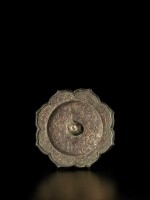
A rare gilt-silver-inset bronze mirror, Tang dynasty | 唐 嵌銀鎏金雙鳳狻猊紋銅鏡
Auction Closed
September 22, 04:06 PM GTNN
Estimate
30,000 - 50,000 USD
Lot Details
Description
A rare gilt-silver-inset bronze mirror
Tang dynasty
唐 嵌銀鎏金雙鳳狻猊紋銅鏡
of floriform with eight petals, the silvered bronze inlaid to one side with a silver sheet with traces of gilt, finely chased with phoenix and mythical beasts encircled by a foliate scroll with birds and chilong, all against a ring-punched ground, centered by a pierced domed knop
Diameter 5⅛ in., 13 cm
collects ion of Stephen Junkunc, III (d. 1978).
來源
史蒂芬•瓊肯三世 (1978年逝) 收藏
Compare a slightly larger mirror of this type also decorated with mythical beast and bird motifs included in the exhibition Animals and Animal Designs in Chinese Art, Eskenazi, New York, 1998, cat. no. 17. See also a related example with six lions around the central knop, now in the Harvard Art Museums, Cambridge (acc. no. 1943.52.168), exhibited in Grenville L. Winthrop: Retrospective for a collects or, Fogg Art Museum, Cambridge, 1969, cat. no. 61, and inscribed with a date corresponding to 682-683 beneath the silver backing. A further gold-inset example from the same collects ion (acc. no. 1943.52.158) was included in ibid., cat. no. 62. Another related mirror was exhibited in Meikyo: Tokyo Orinpikku kinen [Clear Mirrors], The Gotoh Museum, Tokyo, 1964, cat. no. 59.
Additional comparable examples include a mirror in the collects ion of the Penn Museum, Philadelphia, illustrated in Shina-kodo Seikwa or Selected Relics of Ancient Chinese Bronzes from collects ions in Europe and America, Part II Ancient Mirrors, vol. II, Osaka, 1933, pl. 128; one sold in these rooms, 23rd March 2004, lot 592; one published in The Complete collects ion of Treasures of the Palace Museum: Bronze Articles for Daily Use, Hong Kong, 2006, pl. 168; one sold at Christie's New York, 4th June 1987, lot 17; and five smaller examples from the Eumorfopoulos collects ion, now in the collects ions of Metropolitan Museum of Art, New York, and the R. A. Bidwell collects ion, all illustrated in Shina-kodo Seikwa, op. cit., pl. 131.
You May Also Like


