
Property of a Private Collector
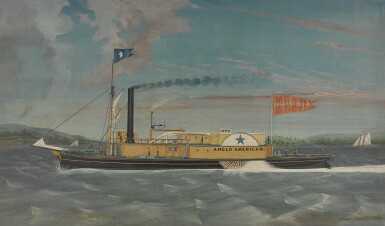
Steamboat 'Anglo American'
Lot Closed
January 21, 04:25 PM GMT
Estimate
30,000 - 50,000 USD
Lot Details
Description
James Bard
1815 - 1897
Steamboat 'Anglo American'
oil on canvas
1849
Height 28 1/2 in. by Width 48 1/2 in.
signed and inscribed Drawn and painted by James Bard, N.Y. 1849 lower right, inscribed Thomas Collyer Builder, N.Y. 1849 lower left
The New York Historical Society, 1936-1995;
Sotheby’s, New York, Important Americana: Property from The New York Historical Society, October 22, 1995, lot 59.
Elaine Andrews, American Landscape and Genre Paintings in the New-York Historical Society: A Catalog of the Collection, Including Historical, Narrative, and Marine Art (New York: New-York Historical Society, 1982), no. 77, p. 23.
Anthony J. Pulso, The Bard Brothers: Painting America Under Steam and Sail (H.N. Abrams, New York, in association with the Mariners’ Museum, 1997), p. 165.
The Anglo-American was a steamship launched in New York in 1849 by the shipbuilder, Thomas Collyer. Thomas Collyer (1818-1862) was a member of a leading family of shipbuilders and operated a boatyard on the East River in Manhattan, where he built over eighty ships throughout his career. The Collyer Brothers also represented the greatest patrons of James Bard, who rendered at least thirty portraits of the steamboats and schooners they built in watercolor and oil paint with precise accuracy.
Twin brothers, James (1815-1897) and John Bard (1815-1897), were the most noteworthy and prolific marine artists of the mid-nineteenth century. Throughout his oeuvre, James Bard illustrated nearly every steamboat and schooner built or owned around the port of New York. Albeit a self-taught artist, Bard possessed a mariner’s eye that contributed to the regard of his paintings as so exacting that one could almost rebuild the vessel based on his painting alone. The detailed draftsmanship of the ship architecture reinforces why Bard received commissions from the most important maritime merchants, steamboat operators, shipbuilders, and captains on the Hudson River and Long Island Sound as a means to record their ships for posterity. Bard’s paintings not only serve as historical documents of the ships at a time when few visual sources existed, but also express how the ships embodied symbols of speed, beauty, and national advancement that irrevocably altered the country’s economic and cultural geography.