
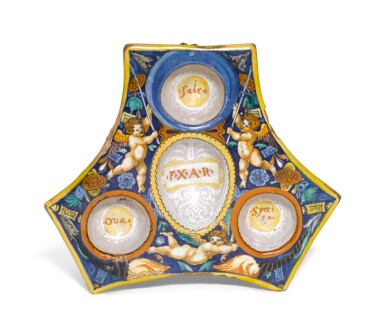
An Italian maiolica egg stand, Urbino, by Francesco Xanto Avelli da Rovigo, circa 1530-35
Lot Closed
May 26, 01:03 PM GTNN
Estimate
15,000 - 25,000 GBP
Lot Details
Description
An Italian maiolica egg stand
Urbino, by Francesco Xanto Avelli da Rovigo, circa 1530-35
of canted triangular form, supported three lion paw feet, the upper surface moulded with an oval well with three circular wells to each point, painted by Francesco Xanto Avelli da Rovigo, signed F.X.A.R. to central well, amongst scrolling foliage in bianco-sopra-bianco, the circular wells insribed Sale, Speci and Ova, the blue ground decorated a trofei among three winged putti
6.5cm.,2 ½in high, 20.5cm., 8in. wide
Christie's South Kensington, The Althorp Attic Sale, 7- 8 July 2010, lot 114.
(II) (B), ITALIAN MAIOLICA, No. 369 - Salt-cellar, painted with Putti, signed by Fr. Xanto Avelli da Rovigo. URBINO. About 1535. X168.
Pieces of form, such as salts, inkstands and candlesticks in early Renaissance Italian maiolica are unusual and pieces signed by Xanto rarer still. The form and decoration of the present stand are reminiscent of the signed and dated triangular salt from the Pucci service formerly in the Bernal collects ion and now part of the British Museum collects ion [1].
The similarity in the decoration of both the putti and trophies and the use of bianco-sopra-bianco to the wells in the surface of each object would suggest both pieces are contemporary to each other. The British Museum salt was exhibited at the Wallace collects ion in 2007 and in the accompanying exhibition catalogue [2] the authors refer to two further salts [3], the second of these, from the `Three Crescents’ service, also of canted triangular form is attributed to a painter thought to have worked closely with Xanto. A piece from the `Three Crescents’ service is dated 1530, further supporting the dating of the present stand.
Early triangular vessels such as salts and spice trays have parallels with European metal prototypes; for example a Spanish silver-gilt spice-stand in the collects ion of the Victoria & Albert Museum [4], is useful as a comparison of form, decoration and scale.
The present stand differs from these other maiolica forms in the unusual shape and arrangement of the wells to the surface of the vessel as well as the descriptive inscriptions to those around the central oviform well bearing Xanto’s monogram. The form of this central well and the inscription to the lower left well, ova, suggest that this stand was intended as an egg stand.
It is also interesting to note in the 17th and 18th centuries, traveling services would somet.mes s include a small egg stand, either made in silver, enamel or Chinese porcelain where the cup would be reversible and could allow the user to rest the egg on its side or upright. This parallels the function of the present stand although silver egg cups in the 16th century appear to be extremely rare [5].
The existence of surviving armorial salts and spice stands suggests they were part of a grand table service or credenza; however, an egg-stand would appear to be a more intimate object, intended for an individual to use in their chambers rather than part of a banqueting display. There are many examples of maiolica potters producing items for personal consumption, in particular pieces from the birthing chamber, somet.mes s referred to as scodella da impagliata. Whilst we can only speculate about for whom and why this item was created, by signing this piece in a most obvious way, Xanto clearly intended the recipient of this small but significant object to be aware of the artist who had created the piece.
[1] Dora Thornton and Timothy Wilson, Italian Renaissance Ceramics a catalogue of the British Museum collects ion, London, 2009, Vol. I, pp. 274-5, no. 162.
[2] J.V.G. Mallet et al., Xanto Pottery Painter, Poet, Man of the Italian Renaissance, London, 2007, pp. 122-3, no. 37.
[3] One is in the collects ions of the Kunstgewerbe-museums, Berlin, signed F.X., the other from the `Three Crescent’ service is attributed to `The Painter of the Milan Marsyas’, Chicago Art Institute, no. 1964.140.
[4] Victoria & Albert Museum, no. M.151-1921.
[5] See the early German parcel-gilt silver egg cup from the Dr Heller’s Lexicon collects ion, sale Replica Shoes ’s, London, 4th December 2012, lot 258.
You May Also Like


