
Property of an Important collects or
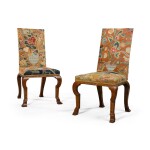
A pair of Queen Anne walnut and marquetry side chairs, circa 1705, attributed to Thomas or Richard Roberts
Auction Closed
November 9, 01:23 PM GTNN
Estimate
40,000 - 60,000 GBP
Lot Details
Description
Property of an Important collects or
A pair of Queen Anne walnut and marquetry side chairs
circa 1705, attributed to Thomas or Richard Roberts
the padded back and seats upholstered in 18th century English needlework, on 'broken' cabriole legs with seaweed marquetry on hoof feet, en suite with previous lot
Thence by descent at Brynkinalt;
Sotheby's London, Of Royal and Noble Descent, 19 January 2017, lot 333 (£62,500).
RELATED LITERATURE
Beard and J. Cross, 'Thomas and Richard Roberts', Apollo, September 1998, pp. 46-48;
G. Beard, Upholsterers and Interior Furnishing in England 1530-1840, London 1997, p. 149 and fig. 167.
This rare group of chairs, offered en suite with lots 13 & 15, were probably commissioned by Sir John Trevor for Trevor House, later Powis House, Knightsbridge and probably removed to Brynkinalt, Denbighshire in the mid-18th century. A prominent figure at Court, Sir John would have been aware of the latest fashions of the t.mes and indeed have been in a position to commission work from Royal chair-makers, Thomas Roberts and/or his son and successor Richard.
The chairs are superb examples of early 18th century craftmanship. The cabriole leg is inlaid with with elegant ‘seaweed’ marquetry employing ‘arabesque’ motifs adapted from French sources, in particular the brass inlay or ‘buhl’ work made fashionable by Andre Charles Boulle (1642-1732). The source of the exotic ‘broken’ cabriole leg, with its exaggerated ‘hoof’ foot, is a mystery and is without precedent in contemporary French furniture. A black lacquered hall chair supplied to Sir Gregory Page (1688-1720), a director of the East India company, provides one of the earliest examples of this form. It has been suggested the design incorporates elements from Chinese furniture, such as k’ang tables of the Ming and early Qing dynasties, which, given the influence of Chinese aesthetics on early Georgian furniture design can collects ing, is highly plausible (see Adam Bowett, English Furniture 1660-1714, From Charles II to Queen Anne, Antique collects ors Club, 2002, pp. 154-155).
A small group of seat furniture of similar but varying design produced in the early 18th century is illustrated by P Macquiod & R Edwards in The Dictionary of English Furniture, Vol. I, pp. 254 – 261. These chairs predominantly feature back splats inlaid with ‘seaweed’ marquetry or padded needlework backs. Macquoid and Edwards point to two possible cabinetmakers as the most likely authors of the examples they illustrate: Thomas Roberts and John Belchier.
The present chairs appear closest to the output of Thomas Roberts; their design is similar to a suite supplied to Sir Robert Walpole, later 1st Earl of Orford (d. 1745) by Roberts for Houghton Hall, Norfolk. They too feature ‘broken’ cabriole legs ending in stylised hoof feet. This important suite comprised of twenty-three chairs and two sofas, eight of which were for the 'Cov'd or Wrought Bedchamber ' and the remainder for the 'Cabinett', two important rooms at the house. Two pairs of chairs from the Houghton suite were sold in the Houghton sale, Christie’s London, 8th December 1994, lots 126 and 127.
Both Thomas and Richard Roberts held the warrant as ‘Joiner to the Royal Household’ for over thirty years, from 1686-1729, and produced furniture for Whitehall, Kensington Palace, Hampton Court and Windsor Castle and even Royal yachts. The Houghton chairs also relate to a further set upholstered with Italian cut velvet and supplied circa 1714-15 for Sir William Humphreys, Lord Mayor of London (R. Edwards, The Shorter Dictionary of English Furniture, London, 1964, p. 135, fig. 75). A further pair of chairs attributed to Richard Roberts (Thomas’ son who continued the family business) with almost identical legs formed part of the commission for Thomas Watson-Wentworth, 3rd Baron Raby at Wentworth Woodhouse, Yorkshire. Like Walpole, wealthy patrons with an eye for the very best in decorative and Replica Handbags available at that t.mes . Clearly Sir John Trevor was acquiring the very best available to him for Powis House.
A further set of seat furniture worthy of mention and historically given to the workshop of John Belchier, was commissioned by John Bowes for Streatlam Castle, Durham. Known for his extensive commission at Erdigg Hall, Wrexham, Belchier supplied ‘mirror glasses, cabinet works and chairs’ of the highest quality. Sir John Trevor would have undoubtedly known about Belchier’s work for John Meller at Erdigg given the proximity between Erdigg and Brynkinalt, as well as the fact that.mes ller was a contemporary of Sir John’s in London, being Master of the Chancery at the beginning of the 18th century.
You May Also Like


