
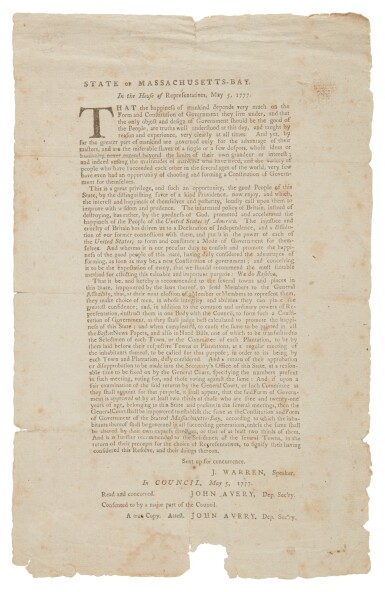
Massachusetts | "The injustice and cruelty of Britain has driven us to a Declaration of Independence"
Auction Closed
November 23, 05:04 PM GMT
Estimate
5,000 - 7,000 USD
Lot Details
Description
Massachusetts
Joseph Warren. State of Massachusetts-Bay. In the House of Representatives, May 5, 1777. That the happiness of mankind depends very much on the Form and Constitution of government they live under, and that the only object and design of Government should be the good of the People, are truths well understood at this day … The injustice and cruelty of Britain has driven us to a Declaration of Independence … and put it in the power of each of the United States, to form and constitute a Mode of Government for themselves. … That it be, and hereby is recommended to the several towns and places in this State … to send Members to the General Assembly … in whose integrity and abilities they can place the greatest confidence … [Boston: Benjamin Edes, ca. 5 May 1777]
Printed broadside (356 x 222 mm). Signed in type by J. Warren, Speaker, and John Avery, Deputy Sec'ry. Bottom and right margins a bit frayed, some scattered spotting, previously folded into four panels. Navy cloth chemise and folding-case, red morocco spine lettered gilt.
"In May 1777 … the General Court reassured citizens that they would indeed get their chance to approve or reject the new state constitution. … After both houses of the General Court … wrote the constitution, the resolve explained, the document would be 'printed in all the Boston News Papers, and also in Hand Bills,' and distributed throughout the state. Each town would hold a meeting at which the constitution would be 'duly considered' and voted on. The General Court would collect these town returns and, if it determined that 'at least two thirds of those who are free and twenty-one years of age' approved the constitution, 'the General Court shall be impowered to establish' it" (Colonists, Citizens, Constitutions, p. 50).
In effect, for various reasons, the proposed 1778 constitution was rejected. By dismissing it, "the people of Massachusetts made an enormously valuable contribution to American constitutionalism" demonstrating that "[t]he people really did have to consent to the fundamental laws that governed political life. And if they did not consent, no power on earth could force them to live under such a government. When the General Court tallied up the returns … it acceded to the popular will and peacefully discarded the document on which its members had labored for months" (Colonists, Citizens, Constitutions, pp. 30–31, passim).
REFERENCE
Colonists, Citizens, Constitutions 8; Evans 15433


