
PROPERTY FROM THE ALBRIGHT-KNOX ART GALLERY
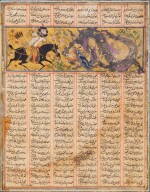
An illustrated and illuminated leaf from a manuscript of Firdausi's Shahnameh (The Second Small Shahnameh): Gushtasp slaying the Dragon of Mount Saqila, Persia or Baghdad, Ilkhanid, circa 1300 AD
Auction Closed
October 27, 03:41 PM GMT
Estimate
10,000 - 15,000 GBP
Lot Details
Description
gouache heightened with gold and silver on paper, 22 lines to the page, above and below the painting, written in small naskh script in black ink in 6 columns, red intercolumnar rules, text within red, gold and black rules, the reverse with 30 lines of text similarly arranged
Painting: 4.2 by 12.3cm; text panel: 16.5 by 13cm; leaf: 25.8 by 19.2cm.
The illustration depicts the brave Iranian prince Gushtasp, astride his horse, fighting a gruesome dragon whose writhing form fills more than half of the pictorial space. Gushtasp had to slay the terrible dragon of Mount Saqila in order to win the hand of the youngest daughter of Caesar.
This folio is from the ‘Second Small Shahnameh’ belonging to an important group of early Shahnameh manuscripts which are of enormous art historical significance. They date from around 1300 AD and are among the earliest surviving illustrated copies of Firdausi's epic. They were dispersed into many museum and private collections in the first half of the twentieth century. The folios from the two manuscripts known as the First and Second Small Shahnamehs were with H.K. Monif in New York, from whence the majority of those in North American collections originated, but several had also entered European collections by then. A group of 77 folios bearing 80 miniatures is in the Chester Beatty Library, Dublin (see Arberry et al, 1959, no.104, pls.4-13), and some are in the British Museum, formerly in the collection of Sir Bernard Eckstein (Brend and Melville, 2010, no.17-20). The majority of the manuscript known as the 'Freer Small Shahnameh' was with Hagop Kevorkian in New York in the 1920s. The 45 folios in the Freer Gallery, Smithsonian Institution, Washington D.C. were acquired from him between 1929 and 1940.
These folios have been extensively published and discussed over the last century by many of the leading scholars in this field, including Kuhnel, Binyon, Wilkinson, Gray, Blochet, Minovi, Barrett, Titley, up to Hillenbrand in 1977. The most extensive and thorough investigation and analysis of this group of manuscripts was conducted by Marianna Shreve Simpson in her PhD thesis entitled The Illustration of an Epic: The Earliest Shahnama Manuscripts, presented to Harvard University in 1978. Simpson concluded that the manuscripts were produced in Baghdad around 1300, although Western Persia remained a possibility. Sheila Canby, in the catalogue accompanying the exhibition of the Prince Sadruddin Aga Khan Collection at the British Museum, discussed the possibility of a Herati origin (Canby, 1998, p.22). In 2002 Carboni and Komaroff, in the catalogue accompanying the exhibition The Legacy of Genghis Khan, reverted to an attribution of Baghdad or Western Persia circa 1300-30 (Komaroff and Carboni 2002, nos.33-35, pp.252-3). In 2010, Barbara Brend attributed four folios to Baghdad dating them to the 1290s (Brend and Melville, op.cit., 2010, nos.17-20). More recently, in the catalogue accompanying the exhibition Epic Iran at the Victoria and Albert Museum in 2021, two folios have been attributed to Persia and dated to circa 1300 (Curtis, Sandmann and Stanley 2021, pp.206-7, cat.nos.156, 157).
Further leaves from the Second Small Shahnameh were sold in these rooms 6 April 2011, The Stuart Cary Welch Collection, Part One, lot 33; 3 October 2012, lot 66; 9 October 2013, lot 81; 27 October 2020, lot 419, and more recently, 31 March 2021, lot 37.
You May Also Like


