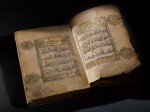

An illuminated Qur’an section, Bust, Ghaznavid, circa 1110 AD
Auction Closed
October 27, 03:41 PM GMT
Estimate
100,000 - 150,000 GBP
Lot Details
Description
text: part 4 of a Qur’an in 15 volumes, surah al-An‘am (VI), v.21 to surah al-‘Araf (VII), v.170
illuminated Arabic manuscript on buff paper, 87 leaves, 7 lines to the page written in bold muhaqqaq-tawqi script in black ink, verses separated by small stylised florets in gold, fifth and tenth verses marked in margins with illuminated devices, further text divisions and sajda and salat points marked with marginal illumination, surah headings marked with a horizontal illuminated panel with a marginal palmette, opening page with large illuminated quatrefoil device, opening double page of text surrounded by panels of elaborate illumination with palmettes extending into margins, contemporary, possibly original stamped leather cover preserved and mounted on upper doublure, outer covers of Safavid or Qajar silk with floral ogival lattice design
21.5 by 14.3cm.
Previously in France and Italy, as per an accompanying note written in French and an Italian export stamp, both from the early 20th century.
The illumination in the present volume is complex and distinctive, and worth describing in further detail. The opening page has a large elaborate central quatrefoil with lotus-petal border containing the words juz’ al-rabi‘ (“fourth section”) in gold Kufic script on a red ground decorated with lotus flowers and split palmettes. Folios 1b-2a contain the opening text written within illuminated rectangular frames each with an upper tripartite panel containing a central pointed oval device bearing the words al-juz’ // al-rabi‘ between two square panels decorated with a checkerboard design, and a lower panel with a bold scrolling lotus vine, and lateral border bands of cablework. Two stylised palmettes extend into the margin at the outer upper and lower corners of the frames. Single verse divisions are marked with small stylised florets illuminated with leaf gold. Fifth verse divisions are marked in the margins with illuminated devices of two forms: one consists of a roundel containing the word khamsa in gold, surmounted by a trefoil finial and resting on a horizontal bar; the other consists of a vertically-oriented stylised palmette containing the word khamsa written in gold. The tenth verse divisions are marked in the margins with a large illuminated roundel containing the word ‘ashr in gold. Further text divisions (juz’, hizb, etc.) are marked in the margins in illuminated square panels in which the relevant words are written in gold Kufic script outlined in white. Some of these panels have corner spandrels and central areas decorated with scrolling foliate motifs in gold on a red-gold ground, while others have stylised lotus flowers on grounds of cross-hatching or tight scrolls. The other text divisions marked include the fourteenth hizb (written as juz’), the eighth juz’, the second quarter, the sixteenth hizb (written as juz’), the ninth juz’, and the eigthteenth hizb. A notable feature is the inclusion of illuminated marginal panels indicating verses relevant to prayers. These consist of two square panels placed one above the other, the upper containing the word salat (prayer) in gold Kufic, and the lower containing the word for the relevant prayer, such as al-maghrib (opposite surah VI, v.50 and surah VII, v.31) and al-fajr (opposite surah VI, v.113, and VII, v.89), also in gold Kufic. The background areas within the panels are decorated with stylised lotus flowers on grounds of cross-hatching or tight scrolls. The heading for surah al-‘Araf (surah VII) is marked with a horizontal illuminated panel containing the surah title in gold Kufic, with a stylised palmette medallion extending into the margin.
The preserved stamped leather cover mounted as the upper doublure is of a style consistent with the date and origin of the manuscript, and may well be part of the original binding. A binding of very similar design on a Seljuk or Ghaznavid Qur’an section of circa 1100 is illustrated in Richard 1997, p.40.
The present manuscript was clearly in Europe in the early twentieth century, for a lengthy description of the manuscript (possibly a dealer’s note) written in ink in a French hand of the period accompanies the manuscript (as well as descriptive notes, it is fulsome in its praise of the “précieuse piece” and “manuscrit inestimable”). Interestingly, it references van Huart’s note on Ibn al-Bawwab on page 80 of his work Les calligraphes et les miniaturistes de l’Orient musulman, published in Paris in 1908, so the letter cannot pre-date that publication, but the handwriting is typical of the early years of the twentieth century. There is also an Italian export stamp reading 'Dogana di Firenze' on the final flyleaf, which may pre-date or post-date the French notes.
The handwritten French note reads as follows:
Une partie du Coran écrite entre le 6eme et 7eme siècle par un calligraphe de premier ordre de son temps, de l’école d’Ibn-Bawab ( voir Huart ,page 80).
De l’écriture de ce précieux objet, on juge facilement que l’écriture de neskhe n’avait pas encore subi le changement ou la réforme que lui a donné Yaghout Mostacemi.
C’est une très précieuse pièce qu’on ne peut trouver nulle part.
Les entêtes, etc, sont écrites en écriture coufique. Les médaillons, les entêtes de chaque chapitre ou chaque Djozu(1)ou chaque Hezb(2) sont faits d’une manière très remarquable.
Le commencement de chaque Sourat est aussi en caractère coufique, encore très répandu dans le temps.
C’est un manuscrit introuvable et inestimable.
—————
(1) Le Coran est composé de 30 Djozu( partie).
(2) chaque Djozu est composé de 4 Hezb.
Sotheby’s is indebted to Marcus Fraser for cataloguing this lot.
You May Also Like


