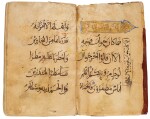

An early illuminated Qur'an section (XX), copied by Muhammad Yunus al-Warraq, Iran or Iraq, late 11th/early 12th century AD
Auction Closed
October 27, 03:41 PM GMT
Estimate
40,000 - 60,000 GBP
Lot Details
Description
text: Juz' XX, surah al-Naml (XXVII) v.56 - surah al-'Ankabut (XXIX) v.45
Arabic manuscript on thick buff paper, 67 folios, 5 lines to the page, written in muhaqqaq-tawqi script in black ink, diacritics in red, blue and black, fifth verses marked with marginal gold devices, tenth verses marked with marginal rosettes pointed in blue and red comprising abjad verse count, juz' heading on the opening page in gold Eastern Kufic script on a red hatched ground within a gold rectangular panel with an illuminated device extending into the margin, surah headings in gold Eastern Kufic script, end of the juz' marked with a narrow gold band, the name of the scribe on the final folio, in original leather tooled binding with a central medallion of knotted strapwork, with later soft leather cover
17.5 by 10.7cm.
This is a very rare example of a late eleventh/early twelfth century Qur’an section in early cursive script, both signed by the scribe and in its original binding.
The script employed and the format of the text suggest that this manuscript was produced when traditional Eastern Kufic script was being used alongside new cursive scripts. The tall muhaqqaq-tawqi script with an emphasis on the vertical is reminiscent of the upright Eastern Kufic scripts of this period. The script of our manuscript is comparable to a Qur’an copied in Bust in Afghanistan, circa 1111-12 AD, now in the Bibliothèque nationale in Paris (illustrated in Richard 1997, no.1, pp.22-23; 37). Another Qur’an section, written in a similar script with long and narrow verticals, is a fragment of a 60-part Qur’an in the Khalili Collection (acc.no. QURI 86; James 1992, no.4, pp.30-33). Attributed to eastern Iran, dated to the twelfth century, the main text of the Qur’an is in muhaqqaq-tawqi with incidental text in both muhaqqaq-tawqi and Kufic. The illumination of our manuscript can further be compared to a Qur’an written in Eastern Kufic script, also attributed to twelfth-century Iran, in the Chester Beatty Library in Dublin (acc. no.1433; illus. in Lings 1976, pl.20). The tooled leather binding of the present lot with its central knot-work medallion finds comparison with the binding of a similar-sized Qur’an section attributed to Iran and dated circa 1100 (Richard, op.cit., no.1 bis, p.19).
For a further illuminated Qur’an section, attributed to Ghaznavid Bust, dated circa 1110 AD, with a comparable style of script, see lot 103 in the present sale.
You May Also Like


