
Property from an American Private Collection
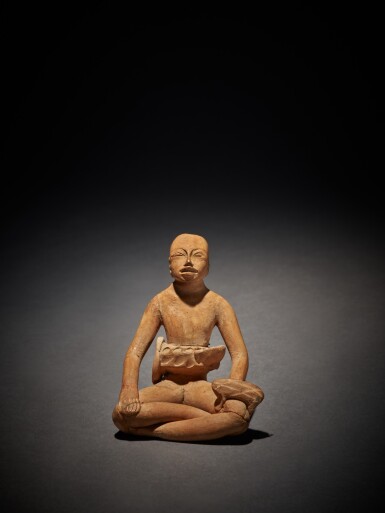
Huastec Seated Ballplayer, Panuco Region Late Preclassic or Protoclassic, circa 300 BC - AD 300
Lot Closed
May 18, 07:47 PM GMT
Estimate
30,000 - 50,000 USD
Lot Details
Description
Property from an American Private Collection
Huastec Seated Ballplayer, Panuco Region
Late Preclassic or Protoclassic, circa 300 BC - AD 300
Height: 3 in (7.5 cm)
Merrin Gallery, New York
American Private Collection, acquired from the above in 1991
The Metropolitan Museum of Art, New York, Before Cortés: Sculpture of Middle America, September 30, 1970 - January 3, 1971
Elizabeth K. Easby and John F. Scott, Before Cortés: Sculpture of Middle America, New York, 1970, p. 177, fig. 139
The corpus of Huastec sculpture is notable for the number of figures which wear the garb of participants in the ballgame, that keystone of Mesoamerican mythology and ritual activity. Amongst the ballgame’s various functions it ceremonialized warfare and sacrifice, settled disputes, and served as a popular pastime while providing a metaphoric reference for life and death (E. Michael Whittington, The Sport of Life and Death: The Mesoamerican Ballgame, New York, 2001, p. 41).
Very few of these Huastec figures, however, possess the exquisite delicacy and refinement of this miniature figure of a ballplayer from Panuco, whose seated posture and supple and graceful body seems almost the antithesis of the robust and mighty ballplayer. In style the present figure relates very closely to a group of six seated figures which Gillett Griffin notes "appear to be depictions of the same person […] modeled by the same master hand". (Griffin in Goldstein, ed., Ceremonial Sculpture of Veracruz, Brookville, 1987, p. 20). Other examples from that tiny corpus include the figure sold at Replica Shoes ’s, New York, May 13, 2019, lot 148, and the figures in the Nelson-Atkins Museum of Art, Kansas City (inv. no. 65-3/3), and the Cleveland Museum of Art (inv. no. 1966.17).
With the deftest of touches, the master sculptor has imbued this subtle and delicate sculpture with life. The pose is serene, dignified, and attentive. The idealized face gazes out with an expression that is both gentle and intent. Around his waist, the ballplayer wears a yoke, with a hip pad on the right. The long, lithe arms are outstretched, with the fingers of the right hand resting gently on the leg, whilst the left hand holds what appears to be a manopla, or hand-stone (see lot 96 in the present auction).
The purpose of this figure is elusive. He is a participant in the ballgame, with its allusions to life and death. We may wonder if, like the seated figures discussed by Griffin, he was perhaps intended to "help or reassure the deceased in his long journey into the strange world of the dead" (ibid., p. 21). This question remains unanswered. What we may appreciate is the beauty and tenderness with which the artist has exalted the dignity of the human figure.
You May Also Like


