
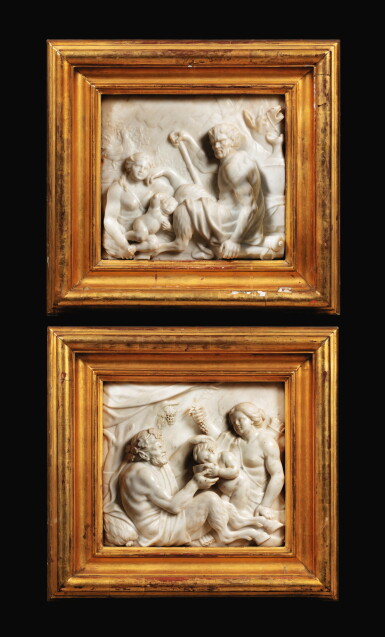
NETHERLANDISH, CIRCA 1700 | A PAIR OF RELIEFS DEPICTING THE EDUCATION OF BACCHUS
Auction Closed
December 3, 07:24 PM GMT
Estimate
10,000 - 15,000 EUR
Lot Details
Description
NETHERLANDISH, CIRCA 1700
A PAIR OF RELIEFS DEPICTING THE EDUCATION OF BACCHUS
white marble; in gilt wood frames
37 x 43 cm; 14½ by 17 in.
__________________________________________________________________
PAYS-BAS, VERS 1700
PAIRE DE RELIEFS REPRÉSENTANT L'EDUCATION DE BACCHUS
marbre blanc ; cadres en bois doré
37 x 43 cm ; 14½ by 17 in.
These two marble reliefs represent the Childhood and Education of the god Bacchus by the satyr Silenus and a maenad. In the first relief, Silenus, serious, surveys Bacchus sleeping alongside a dreaming maenad. Instead of hens, donkeys and plants, a more intimate environment is preferred for the second relief in which Bacchus tastes the wine. Pushed by the satyr who tilts his head, Bacchus greedily tastes the drink while the maenad holds a bunch of grapes above the young god. The figure of Silenus in his role as a teacher educating his adopted son enjoys a great iconographic fortune since Antiquity. A similar scene has been illustrated in the antique marble of Silenus carrying Dionysus as a child, attributed to Lysippus, today in the Louvre Museum (inv. no. MA922).
These reliefs are inspired by the composition of two engravings executed by Charles Le Brun (1619-1690) around 1640, in the British Museum in London (inv. no. 1851,0208.244 and 1874,0808.955). These engravings are part of a series representing the Four Hours of the Day etched by Le Brun at the beginning of his career. Our reliefs take up two scenes with a very similar iconography. We recognize certain details such as the bunch of grapes or the emphasis on the young sleeping Bacchus asleep.
__________________________________________________________________
Ces deux reliefs en marbre blanc représentent l’Enfance et l’Education du dieu Bacchus par le satyre Silène et une ménade. Sur le premier relief, Silène, sérieux, veille sur le sommeil de Bacchus au côté d’une ménade rêveuse. Aux poule, âne et végétaux sont préférés un environnement plus intime pour le deuxième relief dans lequel Bacchus s’attèle à la pratique. Poussé par le satyre qui lui incline la tête, Bacchus goute avidement au breuvage alors que la ménade maintient une grappe de raisin au-dessus du jeune dieu. La figure de Silène dans son rôle de précepteur éduquant son fils adoptif connait une grande fortune iconographique, on la retrouve dès l’Antiquité notamment dans le marbre antique attribué à Lysippe du Silène portant Dionysos enfant aujourd’hui au Musée du Louvre (inv. no. MA922).
Ces reliefs reprennent la composition des deux gravures de Charles Le Brun (1619-1690) exécutées vers 1640 et aujourd’hui conservées au British Museum à Londres (inv. no. 1851,0208.244 et 1874,0808.955). Ces gravures font parties d’un ensemble représentant les Quatre Heures du Jour gravées par Le Brun au début de sa carrière. Nos reliefs reprennent deux scènes d’une iconographie très proche. On y distingue notamment la mise en avant de certains détails comme les grappes de raisin ou encore l’accent mis sur le jeune Bacchus endormi.