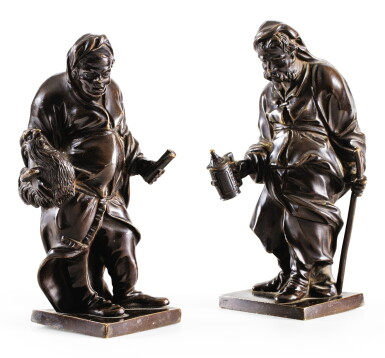
FRENCH, 18TH CENTURY, AFTER PIERRE LEGROS THE ELDER (1629-1714) | AESOP AND DIOGENES
Auction Closed
December 3, 07:24 PM GMT
Estimate
3,000 - 5,000 EUR
Lot Details
Description
FRENCH, 18TH CENTURY, AFTER PIERRE LEGROS THE ELDER (1629-1714)
AESOP AND DIOGENES
a pair of brown patinated bronze figures
H. (Aesop) 16 cm, 6⅓ in.; H. (Diogenes) 16,7 cm, 6½ in.
__________________________________________________________________
FRANCE, XVIIIE SIÈCLE, D'APRÈS PIERRE LEGROS L'ANCIEN (1629-1714)
ÉSOPE ET DIOGÈNE
paire de figures en bronze à patine brune
H. (Esope) 16 cm, 6⅓ in. ; H. (Diogène) 16,7 cm, 6½ in.
Related Literature
F. Souchal, French Sculptors of the 17th and 18th centuries. The reign of Louis XIV, London, 1981, pp. 251-252, fig. 16a.
__________________________________________________________________
Référence bibliographique
F. Souchal, French Sculptors of the 17th and 18th centuries. The reign of Louis XIV, Londres, 1981, p. 251-252, fig. 16a.
These two bronze figures, depicting Aesop holding a cock and a parchment, and Diogenes holding a lantern, were made after the model of Pierre Legros the Elder (1629-1714). The figure of Aesop is based on the model designed by the artist for the famous Versailles Labyrinth built around 1668. The life-size marble figure created between 1672 and 1676 decorated the entrance, whose groves paid homage to the fabulist (today in Versailles, inv. no. 7930). The philosopher Diogenes appears in two fables by Aesop, which probably explains the association of these two figures. These bronzes seem to have been part of a group of philosophers made by Legros and his workshop at the end of the 17th century. Two models comparable to our bronzes are in the Swedish National Museum (inv. no. NMDrhSk 276 and NMDrhSk 277).
__________________________________________________________________
Ces deux figures en bronze, représentant Ésope tenant un coq et un parchemin, et Diogène tenant une lanterne, furent réalisées d’après le modèle de Pierre Legros l’aîné (1629-1714). La figure d’Ésope reprend le modèle conçu par l’artiste pour le célèbre Labyrinthe de Versailles, construit à partir de 1668. La figure grandeur nature en marbre réalisée entre 1672 et 1676 décorait l’entrée de ce lieu dont les bosquets rendaient hommage au fabuliste (aujourd’hui conservée au château, inv. no. 7930). Le philosophe Diogène fut l’objet de deux fables d’Ésope, ce qui explique probablement l’association de ces deux figures. Ces bronzes semblent avoir fait partie d’un ensemble de philosophes réalisés par Legros et son atelier à la fin du XVIIe siècle. Deux modèles tout à fait comparables à nos bronzes sont au Musée national suédois (inv. no. NMDrhSk 276 et NMDrhSk 277).