
Spanish, early 18th century | Fantastical brooch with birds and flowers
Lot Closed
December 16, 01:23 PM GMT
Estimate
15,000 - 20,000 GBP
Lot Details
Description
Spanish, early 18th century
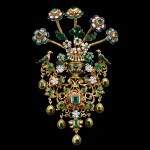
Fantastical brooch with birds and flowers
enamelled gold and emerald
109mm., 4.33in.
This sumptuous brooch illustrates the Spanish fascination with so-called tembladeras, 'trembling' jewels which were popular as hair ornaments. In the 18th century this fashion was extended to brooches, adapted in the form of floral motifs set quivering on small, springy wire spirals, as those seen in the present lot. A closely comparable brooch, dated to the first quarter of the 18th century, is preserved in the Museo Arqueológico in Madrid (illustrated in Muller, op. cit., fig. 242 and Arbeteta, op. cit., no. 117). The general composition is near-identical, with an emerald-set openwork lower section with droplet pendants, surmounted by a vase and two birds, and spiraled wire sprays with enamelled and emerald-set flower terminals. While Muller notes the 'somewhat awkward' juxtaposition of predominantly enamel in the upper, and emeralds in the lower section of the Madrid jewel, the present brooch is a more accomplished piece, distinguished by its intricate openwork and beautifully enamelled floral motifs throughout the composition. In this, the present jewel finds an even closer parallel in a smaller but similarly designed tembladera jewel which served as an aigrette or a brooch, dated to circa 1700 (Arbeteta, op. cit., no. 116).
RELATED LITERATURE
P. E. Muller, Jewels in Spain, 1500-1800, New York, 1972, pp. 157-161; L. Arbeteta, La Joyería Española de Felipe II a Alfonso XIII, Madrid, 1998, pp. 159-161
RELATED LITERATURE
P. E. Muller, Jewels in Spain, 1500-1800, New York, 1972, pp. 157-161; L. Arbeteta, La Joyería Española de Felipe II a Alfonso XIII, Madrid, 1998, pp. 159-161