
The Beauty Within: Gems from the Chenel Collection (lots 31-42)
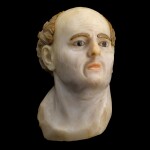
Attributed to the Medici Grand Ducal Workshops, Italian, Florence, circa 1700 | Bust of a Florentine Man
Lot Closed
December 16, 01:32 PM GMT
Estimate
5,000 - 7,000 GBP
Lot Details
Description
The Beauty Within: Gems from the Chenel Collection (lots 31-42)
Attributed to the Medici Grand Ducal Workshops,
Italian, Florence, circa 1700
Bust of a Florentine Man
hardstone
5cm., 2in.
Chenel collection, Paris
This curious hardstone head compares closely with hardstone carvings from the Medici Grand Ducal Workshops in Florence. It finds its comparison in particular with the extraordinary portrait of Johan Wilhelm, Elector Palatine from the Cabinet made for the Elector Palatine in the Museo degli Argenti, Palazzo Pitti, Florence (inv. no. OA 1911:909). Like the Elector Palatine portrait, the present bust has mesmerisingly lifelike eyeballs which have been inserted into the back of the head, and the eyebrows, lips and hair have been created through hardstone inlay onto the flesh-coloured hardstone matrix. The moustache would presumably once also have been inlaid.
The Elector Palatine portrait is believed to be the work of Giuseppe Antonio Torricelli (1659-1719), who was the most important Florentine pietra dura sculptor of the late seventeenth and early eighteenth centuries. Active throughout the reign of Cosimo III de' Medici (r. 1670-1723), Torricelli oversaw the carving of works in pietra dura at the Galleria dei Lavori, the Medici Grand Ducal workshops established in 1588 by Ferdinand I de'Medici (r. 1587-1609). Despite having been trained as a draughtsman by Alessander Rosi (1627-1707), it was probably under Dom Gaetano Zumbo (1656-1701), the famous sculptor of waxworks, that the young Torricelli learned the modelling techniques that formed the foundation of his later career as a virtuoso carver of hardstones.
Torricelli's works are characterised by mesmerising naturalism. The illusionistic techniques he employed can be seen in his famous bust of Grand Duchess Vittoria della Rovere from the Pitti Palace, where the chalcedony head of the figure has been hollowed out to facilitate the insertion of eyeballs that appear so realistic that they have been described as 'vaguely disquieting.' Torricelli boasted that the Vittoria della Rovere was 'the first lifesize portrait created in hardstone, and I made it with great diligence, knowing that it could only be made with much labour by man.' The composition of the Vittoria della Rovere was taken from a model by Giovanni Battista Foggini (1652-1725), as is believed to be the case with many, if not all, of Torricelli's works.
RELATED LITERATURE
W. Koeppe and A. Giusti, Art of the Royal Court. Treasures in Pietre Dure from the Palaces of Europe, New Haven and London, 2008, pp. 13-27, 71-83, 190-91, 203-4; J. Pope Hennessey, Catalogue of Italian Sculpture in the Victoria and Albert Museum, London, 1964, vol. ii, nos. 630, 631, pp. 590-591
The Elector Palatine portrait is believed to be the work of Giuseppe Antonio Torricelli (1659-1719), who was the most important Florentine pietra dura sculptor of the late seventeenth and early eighteenth centuries. Active throughout the reign of Cosimo III de' Medici (r. 1670-1723), Torricelli oversaw the carving of works in pietra dura at the Galleria dei Lavori, the Medici Grand Ducal workshops established in 1588 by Ferdinand I de'Medici (r. 1587-1609). Despite having been trained as a draughtsman by Alessander Rosi (1627-1707), it was probably under Dom Gaetano Zumbo (1656-1701), the famous sculptor of waxworks, that the young Torricelli learned the modelling techniques that formed the foundation of his later career as a virtuoso carver of hardstones.
Torricelli's works are characterised by mesmerising naturalism. The illusionistic techniques he employed can be seen in his famous bust of Grand Duchess Vittoria della Rovere from the Pitti Palace, where the chalcedony head of the figure has been hollowed out to facilitate the insertion of eyeballs that appear so realistic that they have been described as 'vaguely disquieting.' Torricelli boasted that the Vittoria della Rovere was 'the first lifesize portrait created in hardstone, and I made it with great diligence, knowing that it could only be made with much labour by man.' The composition of the Vittoria della Rovere was taken from a model by Giovanni Battista Foggini (1652-1725), as is believed to be the case with many, if not all, of Torricelli's works.
RELATED LITERATURE
W. Koeppe and A. Giusti, Art of the Royal Court. Treasures in Pietre Dure from the Palaces of Europe, New Haven and London, 2008, pp. 13-27, 71-83, 190-91, 203-4; J. Pope Hennessey, Catalogue of Italian Sculpture in the Victoria and Albert Museum, London, 1964, vol. ii, nos. 630, 631, pp. 590-591