KATSUSHIKA HOKUSAI (1760-1849) POEM BY TENCHI TENNO | EDO PERIOD, 19TH CENTURY
Lot Closed
October 8, 01:22 PM GMT
Estimate
8,000 - 10,000 GBP
Lot Details
Description
KATSUSHIKA HOKUSAI (1760-1849)
EDO PERIOD, 19TH CENTURY
POEM BY TENCHI TENNO
woodblock print, from the series The Hundred Poems [By the Hundred Poets] as Told by the Nurse (Hyakunin isshu uba ga etoki), signed saki no Hokusai manji, published by Nishimuraya Yohachi (Eijudo), censor's seal kiwame, circa 1835-36
Horizontal oban:
23.9 x 35.5 cm, 9½ x 14 in.
To view Shipping Calculator, please click here
Okayama Museum, Okayama, 29 October - 23 November 1983
Hokusai, National Gallery of Victoria International, Melbourne, 21 July - 15 October 2017
Peter Morse, Hokusai: One Hundred Poets (New York, 1989), pp. 26-27, no. 1
S. Nagata, Hokusai Museum (Hokusai Bijutsukan): Tales (Monogatari-e), vol. 5, 2nd ed. (Tokyo, 1990), pl. 129
Okayama Museum, Tokubetsu-ten Hiroshige to Hokusai Rokuju yoshu meishozu-e to Hyakunin isshu uba ge etoki (Sakai Collection), Okayama Museum, Okayama, 29 October - 23 November, exhib. cat (Okayama, 1983), pl. 1
W. Crothers, T. Kobayashi and J. Berndt, Hokusai, NGV International, Melbourne, 21 July- 15 October 2017, exhib. cat. (Melbourne, 2017) p. 168
For his last single sheet series of woodblock prints, One Hundred Poems Explained by the Nurse (Hyakunin isshu uba ga etoki), Katshushika Hokusai looked to an anthology of well-known poems, entitled Hyakunin Isshu (A Hundred Poems by a Hundred Poets), as his source. These poems, based on love and melancholy, were assembled by the thirteenth-century poet Fujiawara no Teika. Hokusai chose to visually recount the poems from the perspective of a fictional elderly nurse. Together with sixty-four preparatory drawings, twenty-seven published prints are known, each exhibiting bold colour and including a cartouche enclosing the relevant verse. The series was commissioned by the publisher Nishimura Yohachi and his firm Eijudo successfully issued five prints before closing down; the additional twenty-two prints were then published by Iseya Sanjiro’s firm Iseri, with the original Eijudo seal continuing to be employed.
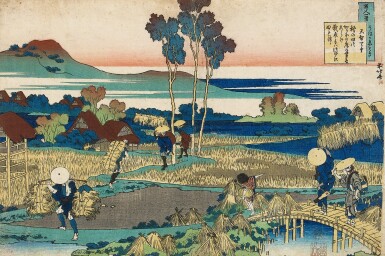
The poem in this print was written by Emperor Tenchi Tenno (628-681) and describes how he sheltered in the hut of a rice farmer during an autumnal rain storm.
Aki no ta no
Kario no io no
Toma wo arami
Waga koromode wa
Tsuyu ni nure-tsutsu
Coarse the rush-mat roof
Sheltering the harvest-hut
Of the autumn rice-field
And my sleeves are growing wet
With the moisture dripping through
Tenchi Tenno draws attention to his drenched sleeves, a reference, it has been said, to weeping for the hard-working people of the land, for whom he felt great empathy. Hokusai depicts these labourers at sunset, harvesting their crops after a long day of work.
For another impression in The Museum of Replica Handbags s, Boston, see accession no. 21.6714