
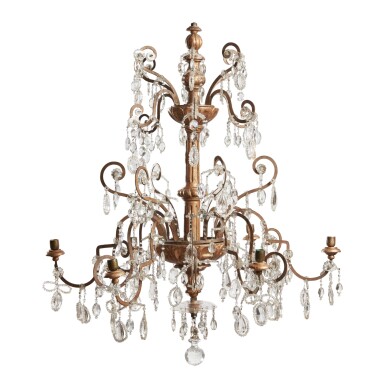
AN ITALIAN GILTWOOD, GILT-METAL AND CUT CRYSTAL SIX-LIGHT CHANDELIER, GENOA, 18TH CENTURY AND LATER
Auction Closed
January 25, 03:59 AM GMT
Estimate
5,000 - 8,000 USD
Lot Details
Description
AN ITALIAN GILTWOOD, GILT-METAL AND CUT CRYSTAL SIX-LIGHT CHANDELIER, GENOA, 18TH CENTURY AND LATER
height 41 in.; diameter 35 in.
104.1 cm; 88.9 cm
Nancy Lancaster, Haseley Court, Oxfordshire
Christie's London, 28 November 1974, lot 47
C. Jones, Colefax & Fowler: The Best in English Interior Decoration (London 1989), ill. p.29
R. Becker, Nancy Lancaster: Her Life, Her World, Her Art (New York 1996), ill. p.350
M. Wood, Nancy Lancaster. English Country House Style (London 2005), ill. p.139.
Following her divorce from her third husband Claude Lancaster in 1753, Nancy Lancaster acquired Haseley Court outside Oxford in 1754. An amalgam of medieval, Queen Anne and later Georgian elements, Haseley was in a near derelict state, lacking electricity and bathrooms, suffering from dry rot, and still scarred from the war years when American troops had been billeted there. This was her first major project with John Fowler, aided by the painter George Oakes, and the collaboration was a triumph, notably in the Palladian Room which was painted in simulated Chinese wallpaper based on an 18th century sample from Drottningholm Palace in Sweden, and the Gothic Room with trompe-l'oeil stucco decoration, again painted by Oakes, that was so realistic Nancy herself was deceived upon seeing it the first time.
Lancaster re-used furniture from her previous houses Ditchley, Kelmarsh and even Mirador in Virginia, complemented with new purchases across all styles and periods, in her now familiar pattern of mixing stately furniture with simpler pieces to maintain an equilibrium of elegance and informality. Nowhere was this more in evidence than in the dining room, where the offered lot hung in the centre above a fruitwood gateleg table surrounded by Regency dining chairs with distressed leather deliberately left unrestored, opposite a George III giltwood rococo oval mirror above a black lacquer cabinet. The arrangement perfectly illustrated one of Nancy's key design principles: 'I never think that sticking slavishly to one period is successful, a touch of nostalgia adds charm. One needs light and shade because if every piece is perfect the room becomes a museum and lifeless.'
Lancaster's years at Haseley were among the happiest of her life, and she frequently entertained visitors including her aunt Nancy Astor, Lady Diana Cooper, the Duke of Wellington, and Cecil Beaton, who wrote that Haseley 'could not be more beautiful to the spirit...every nook and corner is of an offhand perfection'. Unfortunately a tragic fire struck the property in 1970, and this, combined with Lancaster's diminishing capital, compelled her to sell Haseley and move into a smaller coach house on the estate, sending many works from its interior to auction, including this chandelier