
PROPERTY FROM A SPANISH COLLECTION
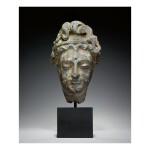
A GREY SCHIST SANDSTONE HEAD OF A BODHISATTVA, ANCIENT REGION OF GANDHARA, 2ND/3RD CENTURY
Auction Closed
September 22, 07:46 PM GMT
Estimate
80,000 - 120,000 USD
Lot Details
Description
PROPERTY FROM A SPANISH COLLECTION
A GREY SCHIST SANDSTONE HEAD OF A BODHISATTVA
ANCIENT REGION OF GANDHARA, 2ND/3RD CENTURY
Height 19 ¾ in. (50 cm)
the bodhisattva with oval shaped face, heavy-lidded almond eyes articulated by broad arching eyebrows, a curling mustache extending widely across the lips and rounded chin, the hair set in undulating waves across the forehead secured with a double-looped knot with the ends cascading to either side in soft curls, wearing a double beaded diadem secured with a cylindrical bead at center and flanked by two floral shaped beads
Collection of a Spanish Ambassador, acquired in Pakistan in the 1960s
This highly attractive and monumental head is a superlative example of the Gandharan style of sculpture that flourished in the northwestern part of the Indian subcontinent from roughly the 1st through the 5th centuries of the Common Era. The region of Gandhara, which comprised parts of modern-day Pakistan and Afghanistan, was strategically located at the hub of the ancient Silk Routes and was an area of prime military and commercial significance in antiquity. The region was particularly influenced by Hellenistic culture resulting from the military campaign of Alexander the Great in the 4th century B.C.E. The legacy of Hellenism that he left in his wake was integrated with local traditions creating a multi-cultural lexicon out of which was born the Gandharan School of art, a unique amalgam of East and West. Gandharan sculptures, as seen in the present lot, are executed in a strongly 'Classical' Greco-Roman style that was applied to a purely Buddhist and Indic iconography.
The hybrid character of Gandharan art found powerful expression in Buddhism, a new religion that was founded in northern India towards the end of the first Millennium before the Common Era. The Buddhist creed, which placed emphasis on righteous and moral deeds as the path to salvation, was embraced by the cosmopolitan population of Gandhara under the patronage of successive Indo-Greek rulers. This patronage was continued by the mighty Kushan emperors who oversaw the construction of hundreds of Buddhist temples and monasteries throughout their domain.
By the beginning of the Common Era, two strains or schools of thought had emerged in Buddhism, of which the Mahayana or the Greater Vehicle form was popular in the region. Mahayana ideology advocated the expression of love and devotion to the Buddhist principle as the chief element in the attainment of salvation. The medium through which this possibility of salvation was advanced was the Bodhisattva (translated as Enlightenment Being), a sentient being who is ready to receive Enlightenment but voluntarily postpones his own nirvana to transfer his merit to others so that they may cleanse their souls and achieve salvation. This altruistic deity was thus revered as a repository of benevolence and compassion and his images were created in large numbers by practitioners of the faith.
This elegantly modeled face displays the classic fusion of Indic and Hellenistic artistic traditions that characterized Gandharan art. Indeed, the double-looped topknot crowing the deity's head is reminiscent of the kroibolis of the Apollo Belvedere and points directly to Greek influence. The serene countenance with its contemplative and deeply spiritual expression is masterfully executed. The jeweled headdress is part of the rich suite of aristocratic accoutrements known as bodhisattvabharana, which indicated the deity's divine identity and also acted as symbols representing the material and spiritual wealth to be gained by lay worshipers.
Compare the arrangement of the hair and headdress to a standing Bodhisattva; see H. Ingholt, Gandharan Art in Pakistan, New York, 1957, no. 295. Also compare the countenance of the face to a standing Bodhisattva in the British Museum, see W. Zwalf, A Catalogue of Gandhara Sculpture in the British Museum, 1996, no. 50.