
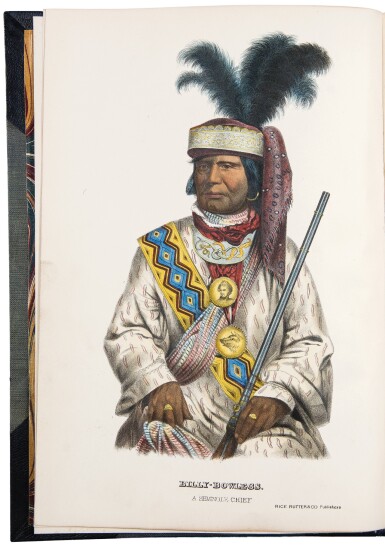
Mckenney, Thomas Loraine, and James Hall | The rare edition, which completes the list of 122 plates from Indian Tribes of North America
Lot Closed
December 16, 10:42 PM GMT
Estimate
6,000 - 8,000 USD
Lot Details
Description
Mckenney, Thomas Loraine, and James Hall
History of the Indian Tribes of North America, with biographical sketches and anecdotes of the principal chiefs. Embellished with one hundred portraits from the Indian Gallery in the War Department at Washington. Philadelphia: [Caxton Press of Sherman & Co. for] D.Rice & Co., 1872
2 volumes, 4to (2656 x 184 mm). 1 hand-colored lithographic portrait of "Billy Bowlegs". Navy half morocco over original blue cloth-covered boards, spines with raised bands in five compartments, second and fourth gilt-lettered, the others with repeat decorative motif in gilt, edges gilt, marbled endpapers; rebacked to style.
A very rare edition of McKenney and Hall, with the portrait of Billy Bowlegs
The incredibly scarce Billy Bowlegs image completes the list of 122 plates from McKenney & Hall's iconic Indian Tribes of North America (i.e. 120 plates in the folio edition, the rare portrait of Jaw-Beance, and the Billy Bowlegs portrait). Bowlegs was born into a family of hereditary chiefs descended from Cowkeeper of the Oconee tribe of the Seminole in the village of Cuscowilla on the Alachua savannah (present-day Payne's Prairie, near Micanopy, Florida). His father's name was Secoffee, while it is thought that the chief Micanopy was his uncle. The surname "Bowlegs" may be an alternate spelling of Bolek, a preceding Seminole chief.
Although Bowlegs signed the Treaty of Payne's Landing of 1832, he refused to leave Florida. Bowlegs and his band of 200 warriors became some of the most prominent fighters surviving at the time hostilities ended on 14 August 1842. To impress and awe the Seminole chiefs, the US government brought Bowlegs to Washington, D.C. to underline the power of the United States.
Bowlegs and his band lived in relative peace until 1855. A group of army engineers and surveyors invaded his territory in southwestern Florida, where they cut down banana trees and destroyed other property in the course of building forts. Some historians have viewed these actions as intentional provocation to make Bowlegs react, so the settlers would have a reason to force the Seminole out. If so, the provocation worked: Bowlegs led his warriors in sporadic attacks against settlers for the next few years, in what is known as the Third Seminole War. The Army was unable to subdue his guerrilla warfare.
In early 1858, Chief Wild Cat of the Western Seminole was brought back from Indian Territory to convince Bowlegs to relocate voluntarily. The US government offered Bowlegs $10,000 and each of his chiefs $1000 if they did so. Warriors and non-warriors were offered less. They initially refused but later that year, the band of 123 agreed to relocation. Billy's Creek in downtown Fort Myers, Florida is named after Bowlegs as this was the spot where he was forced to surrender in 1858.
In May, Bowlegs and his followers arrived in New Orleans, en route to Arkansas and their new home in the Indian Territory. A journalist described the chief as having "two wives, one son, five daughters, and a hundred thousand dollars in hard cash." After reaching Indian Territory, Bowlegs became a leading chief there. He and his daughters became prominent land holders.
REFERENCE
This edition not in Field, Howes, or Sabin