
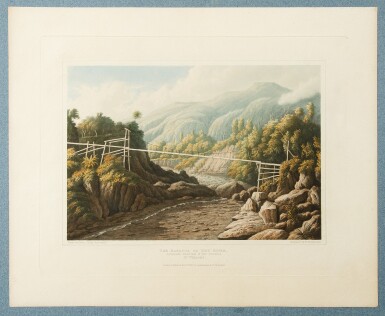
Caddy, Lieut. John Herbert. Among the most desirable 19th century views of the West Indian landscape
Lot Closed
October 15, 04:30 PM GMT
Estimate
30,000 - 40,000 USD
Lot Details
Description
CADDY, LIEUTENANT JOHN HERBERT
[SCENERY OF THE WINDWARD AND LEEWARD ISLANDS]. LONDON: ACKERMANN & CO., 1837
Oblong folio (16 x 22 in.; 406 x 559 mm). 12 hand colored aquatints after Caddy engraved by Fielding, Harris, Hunt and Westall (each print approx: 12 3/4 x 15 1/2 in.; 324 x 394 mm), each tipped onto sheet of blue paper, complete without text, as issued. Bound to style in half period dark blue morocco and buff paper colored boards. Housed in a dark blue morocco box.
Aquatints include:
1. Brimstone Hill / St. Kitts. [Engraved by J. Harris]
2. Fort Charlotte, St. Vincent's / from Kingston. [Engraved by N. Fielding]
3. The Old Crater of the Soufriere / St. Vincent. [Engraved by W. Westall]
4. The Pitons or Sugar-loaves / St. Lucia. [Engraved by C. Hunt]
5. Sandy Point, St. Kitts. [Engraved by C. Hunt]
6. Pigeon Island, & Village of Gros Islet / St. Lucia. [Engraved by J. Harris]
7. The Town of Castries / St. Lucia. [Engraved by N. Fielding]
8. Kingstown / St. Vincent's / from Cane-Garden Point. [Engraved by J. Harris]
9. View from Morne Fortune / St. Lucia ... [Engraved by J. Harris]
10. Roseau, Dominica. [Engraved by J. Harris]
11. The Rabacca or Dry River / Soufriere Mountain in the distance / St. Vincent. [Engraved by W. Westall]
12. Basaltic Rocks / in Washilabou or Cumberland Valley, St. Vincent. [Engraved by W. Westall]
Among the most desirable 19th century color aquatint views of the West Indian landscape—a rare complete set
"John Herbert Caddy was born into a family of military engineers. His grandfather had been sent to Newfoundland in the 18th century to build a fort. In about 1796 his father left Kent, England, for a posting in Lower Canada and in 1808 was transferred to the garrison at Fort Malden, Amherstburg, Upper Canada. John Herbert began his schooling at Amherstburg and in 1815 he was sent to England for military training at the Royal Military Academy, Woolwich (now part of London). In March 1816 he was enlisted at the academy as a gentleman cadet in the Royal Artillery and received training as an engineer and cannoneer. Like George Heriot, James Pattison Cockburn, Philip John Bainbrigge, and other English military artists who painted Canadian scenes, Caddy was trained at Woolwich in topographical sketching and painting. Much of his free time was spent at the home of a family friend, Colonel Richard Hamilton, at Woolwich Common. Caddy was commissioned 2nd lieutenant on 29 July 1825 and promoted 1st lieutenant in 1827. In 1828 he married Colonel Hamilton's daughter Georgiana, shortly before he left for duty in Tobago. He returned to England in 1831, but after two years left his family for his second West Indian posting, at St Lucia. In May 1834 he was transferred to St Vincent where he was joined later by his wife and family. Diary fragments describe the social rounds, the hunting, and the sketching which were possible with light military duties. Before he left for St Vincent Caddy had prepared for publication a series of four folios of scenes, largely of the West Indies. The pictures of the first folio were engraved in London and were published in 1837 by Ackermann; the other three folios never appeared" (Dictionary of Canadian Biography).
This suite of plates was issued without text or title (the title above as supplied by Abbey from the lettering on the cover of the binding on his set). The work was published, as a contemporary advertisement reveals, as a suite of "highly colored views" for £3.10.
REFERENCE:
Abbey, Travel II:692; Sabin 9824; The Exotic and the Beautiful I:04