
Property from a New York collects ion
Tiffany Studios
"Hibiscus" Vase
Auction Closed
December 11, 12:30 AM GTNN
Estimate
10,000 - 15,000 USD
Lot Details
Description
Property from a New York collects ion
Tiffany Studios
"Hibiscus" Vase
circa 1897
carved and acid-etched favrile glass
engraved o2582 with the firm's paper label
4 7/8 in. (12.4 cm) high
collects
ion of Duane Black, Naples, Florida
Acquired from the above by the present owner
Acquired from the above by the present owner
Martin Eidelberg, Tiffany Favrile Glass and the Quest of Beauty, New York, 2007, p. 52 (for related examples)
Cameo vases were part of the early output of the Stourbridge Glass Company, Louis Tiffany’s glasshouse in Corona, Long Island, appearing as early as 1896. This was to be expected, considering Tiffany’s personal knowledge of Emile Galle’s work in France and that Arthur J. Nash, the glasshouse’s superintendent, was formerly the manager of the Webb glassworks in Stourbridge, England, a company famous for its cameo glass.
Tiffany and Nash, however, decided not to imitate the flat, static designs largely favored by Gallé, nor the rigid, classic motifs of Webb. In order to create a more fluid and naturalistic style, a new technique had to be developed that differed radically from the European method of forming a vase with multiple layers of glass and then using acid to cut away those layers. Tiffany’s glassworkers instead “padded” irregular sections of colored glass onto the exterior surface of the body and then a skilled craftsman used cutting and engraving tools, instead of acid, to refine the design. It was a far more expensive and t.mes -consuming process, but it gave Tiffany the look he desired.
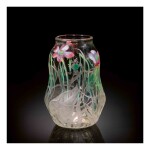
The cameo vase offered here clearly demonstrates the finest artistic possibilities of the technique. The shoulder of the transparent body features superbly carved representations of what is probably a type of hibiscus better known as a “Swamp Rose Mallow,” with gently undulating and folded white, pink and red petals encircling a finely carved bright green pistil. Below the flowers are several green buds with incised details and the lower half of the body is superbly engraved with tall, slender grasses and spade-shaped veined leaves.
This piece is likely the work of Fredolin Kretschmann, at the t.mes one of the world’s greatest engravers. Born in 1845, Kretschmann was a native of Austria and moved to England at the age of 19, where he learned his craft. He received numerous prestigious awards throughout Europe, including the Legion of Honor. Tiffany hired Kretschmann to work for the Stourbridge Glass Company after seeing his work at the 1893 Columbian Exposition and his reputation was such that Kretschmann’s vases sold for as much as $1,500 to clients that included the Goulds, Vanderbilts and Havemeyers. Kretschmann unfortunately died suddenly on August 6, 1898. Shortly after his death, the company was bemoaning that his “work was almost unique, and whose recent death has created a vacancy which is found almost impossible to fill.”
PAUL DOROS
Tiffany and Nash, however, decided not to imitate the flat, static designs largely favored by Gallé, nor the rigid, classic motifs of Webb. In order to create a more fluid and naturalistic style, a new technique had to be developed that differed radically from the European method of forming a vase with multiple layers of glass and then using acid to cut away those layers. Tiffany’s glassworkers instead “padded” irregular sections of colored glass onto the exterior surface of the body and then a skilled craftsman used cutting and engraving tools, instead of acid, to refine the design. It was a far more expensive and t.mes -consuming process, but it gave Tiffany the look he desired.
The cameo vase offered here clearly demonstrates the finest artistic possibilities of the technique. The shoulder of the transparent body features superbly carved representations of what is probably a type of hibiscus better known as a “Swamp Rose Mallow,” with gently undulating and folded white, pink and red petals encircling a finely carved bright green pistil. Below the flowers are several green buds with incised details and the lower half of the body is superbly engraved with tall, slender grasses and spade-shaped veined leaves.
This piece is likely the work of Fredolin Kretschmann, at the t.mes one of the world’s greatest engravers. Born in 1845, Kretschmann was a native of Austria and moved to England at the age of 19, where he learned his craft. He received numerous prestigious awards throughout Europe, including the Legion of Honor. Tiffany hired Kretschmann to work for the Stourbridge Glass Company after seeing his work at the 1893 Columbian Exposition and his reputation was such that Kretschmann’s vases sold for as much as $1,500 to clients that included the Goulds, Vanderbilts and Havemeyers. Kretschmann unfortunately died suddenly on August 6, 1898. Shortly after his death, the company was bemoaning that his “work was almost unique, and whose recent death has created a vacancy which is found almost impossible to fill.”
PAUL DOROS