
PROPERTY FROM AN IMPORTANT EUROPEAN COLLECTION
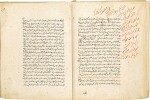
KHWAND AMIR (D.1534), HABIB AL-SIYAR, VOL.3.2 (A HISTORY OF THE TIMURIDS AND THEIR DESCENDANTS), INDIA OR CENTRAL ASIA, DATED 978 AH/1570 AD, WITH MARGINAL NOTES IN THE HAND OF THE MUGHAL EMPEROR SHAH JAHAN
Auction Closed
October 27, 04:55 PM GMT
Estimate
20,000 - 30,000 GBP
Lot Details
Description
A HISTORICAL MANUSCRIPT WITH HAND-WRITTEN NOTES BY THE MUGHAL EMPEROR SHAH JAHAN
PROPERTY FROM AN IMPORTANT EUROPEAN COLLECTION
KHWAND AMIR (D.1534), HABIB AL-SIYAR, VOL.3.2 (A HISTORY OF THE TIMURIDS AND THEIR DESCENDANTS), INDIA OR CENTRAL ASIA, DATED 978 AH/1570 AD, WITH MARGINAL NOTES IN THE HAND OF THE MUGHAL EMPEROR SHAH JAHAN
Persian manuscript on paper, 487 leaves, 21 lines to the page, written in black nasta'liq script, occasional marginal annotations in red ink in Shah Jahan's hand, several undated seal impressions, tan leather binding with central stamped medallions, with flap, bespoke box
24.1 by 18cm.
Sold in these rooms, 8 October 2014, lot 221.
This fascinating manuscript of Khwand Amir's Habib al-Siyar (literally 'Beloved of Careers') is remarkable for its provenance, having been in an Uzbek Library before passing into the possession of the Mughal Emperor Shah Jahan (r.1628-58), who added marginal notes in his distinctive hand. The Emperor’s notes are loosely formed and stand out against the meticulous nasta’liq form of the main text; certain letter forms closely match other samples of Shah Jahan’s writing. (See J. Seyller 'The Inspection and Valuation of Manuscripts in the Imperial Mughal Library,' Artibus Asiae, vol.57, no¾, 1997, pp.243-349, figs.1 and 6 and a flyleaf note on the Freer’s Haft Manzar manuscript).
Shah Jahan’s notes and commentary (several of which have been partially erased at a later date) provide an interesting glimpse into the opinions and thoughts of the emperor and of the Mughal court towards other ruling dynasties and current events. As can be seen below, in a comment on Folio 258a, the King suggests that the blackening of parts of the text was due to a pro-Uzbek leader. In a note with F.229a, he criticises the author of this manuscript.
Among the marginal notes are the following:
F.141a. “It was Saturday, the last day of rabi’ al-awwal, the year 1031 (12 February, 1622). It was written in Chahar Kuruji (Guruhi?) of Multan. His Majesty (Jahangir) had gone to Karkub on a pleasure trip. It was 24 bahman and the day before yesterday, and the night was raining.” (This date must refer to when his majesty had gone to Karkub because the equivalent of the above date should be 30 bahman).
During this period Jahangir was moving north from Agra due to extreme heat and was touring in the hill country north east of Lahore (tuzuk-e-jehangiri, pp.383-390) but there is no mention of the above places in his movements.
F.229a. The note is a criticism towards the author for calling ‘Ali the brother of Muhammad and omitting the prayer after his name, which he (Shah Jahan) calls ignorance and fanaticism, and that he (Shah Jahan) added it in black (which is visible in the text, though faint).
F.258a. The marginal commentator describes the blackening of parts of the text as the work of a pro-Uzbek reader.
F.321a. “It was written on 21 safar, the year 1031 (5 January 1622) in the maqam of Buriya(?)...yesterday, His Majesty returned from his tour of Hardawar.”
Folio 417b. “From here there are many lies” a few lines have been crossed in red.
The notes on the first page of the manuscript provide important details, such as the subject, author and additional commentary on the text, as well as describing the transfer of the book from librarian to another. They are as follows:
“The account of Amir Timur Gurkan in details with his children up to the time of Babur Padshah, and the accounts of the Uzbeks, Qizilbash, and Safavid kings and accounts of the learned men, the shaykhs and… of that period.”
“The red hand which appears on the margins of this book are His Majesty Shah Jahan Padshah who has in many places criticised previous rulers.”
“It was transferred to La’l Chand to Mulla Muwajjah” The date is given as ilahi (Divine), this means that it could only be Jahangir or Shah Jahan.
“It was transferred from…Akbar Quli on 11 muharram, the year 1061 (25 December 1650).”
“I bought (it) from Sayyid Shirazi the book seller in the tin maker’s bazar in Tehran in 1344 [1925]. Value is 30 (touman), this has been written both in words and in siyaqat.
The seal on F.1b is possibly a Mughal seal but may not be royal.
There is a note suggesting that the book belongs to Isma’il, son of Mir Muhammad Ma’sum on the final page, however it has no date. The final page also has a poem written on the death of ‘Abd al-Mu’min Khan, who was perhaps the Uzbek ruler.