
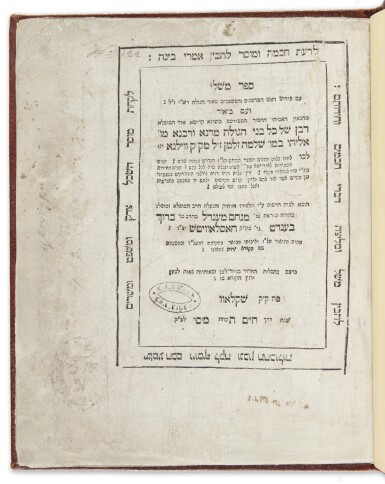
PROVERBS WITH THE COMMENTARY OF RABBI ELIJAH BEN SOLOMON ZALMAN OF VILNA, EDITED BY RABBI MENAHEM MENDEL BEN BARUCH BENDET OF SHKLOV, SHKLOV, 1798
Auction Closed
November 20, 08:47 PM GMT
Estimate
8,000 - 10,000 USD
Lot Details
Description
PROVERBS WITH THE COMMENTARY OF RABBI ELIJAH BEN SOLOMON ZALMAN OF VILNA, EDITED BY RABBI MENAHEM MENDEL BEN BARUCH BENDET OF SHKLOV, SHKLOV, 1798
77 folios (10 1/8 x 8 1/8 in.; 255 x 207 mm).
The first edition of the Gaon of Vilna’s first published commentary.
Rabbi Elijah ben Solomon Zalman, better known as the Gaon of Vilna (1720-1797), was the intellectual and spiritual leader of Lithuanian, non-Hasidic Jewry. His overwhelming authority and influence, both during his lifetime and in death, are due to his legendary piety, asceticism, and, of course, prodigious genius. Over seventy monographs and commentaries in virtually every field of traditional Jewish scholarship are attributed to him. A portion of these have survived in R. Elijah’s own hand. Many others were compiled by his sons and close students, based on lectures he gave or marginalia he left in his books; the present title is one such work.
Rabbi Menahem Mendel of Shklov (d. 1827) was part of the inner circle of the Gaon of Vilna. Together with his brother Simhah Bunem and Rabbi Hayyim of Volozhin, he recorded R. Elijah’s lessons and helped disseminate them after their master’s passing. In his introduction to this volume, he writes that R. Elijah directed him to publish this commentary first (an order which he followed). He goes on to explain that kabbalistic material appearing in the book was recorded verbatim based on the Gaon’s direct dictation but that non-esoteric teachings were formulated in R. Menahem Mendel’s own words immediately after he heard them from his mentor. Among non-Pentateuchal biblical literature, R. Elijah attached particular importance to the book of Proverbs, even requiring girls to acquire a knowledge of it so that they could conduct themselves in accordance with its principles.