Property from a European Private collects ion (Lots 1-5)
BYZANTINE, 11TH/ 12TH CENTURY AND LATER | PENDANT RELIQUARY CROSS
Auction Closed
July 2, 02:29 PM GTNN
Estimate
30,000 - 50,000 GBP
Lot Details
Description
Property from a European Private collects ion (Lots 1-5)
BYZANTINE, 11TH/ 12TH CENTURY AND LATER
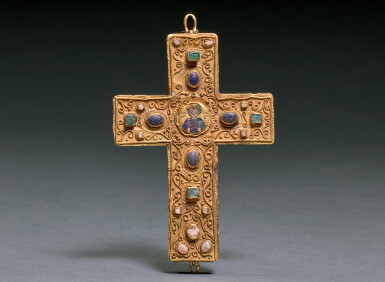
PENDANT RELIQUARY CROSS
gold, set with cabochons and filigree, and cloisonné enamelled gold
the cross: probably Italian, 12th/ 13th century
the roundel with the Virgin (probably associated): Byzantine, 11th/ 12th century
13.2cm., 5¼in. overall (excluding loops)
roundel: 19mm., ¾in. diameter
Adolphe (1871-1949) and Suzanne Stoclet, Brussels;
thence by descent;
private European collects ion
Reliquary crosses were made throughout the centuries during the existence of the Byzantine Empire. While the combination of mounted roundels and cabochons is a feature of 11th-century reliquaries from Constantinople (cf. M.C. Ross, op. cit., no. 154), the filigree scrollwork and the central placement of the enamel on a cross only seem to occur on later objects, namely from the Greek and Italian outliers of the empire (see M.C. Ross, op. cit., no. 159 and Cormack and Vassilaki, op. cit., no. 188). There seems to be a particular concentration of such crosses in Italian church treasuries, even though the origin of most of these objects is unclear (Hackenbroch, op. cit., figs. 31-54 and 65-66). The roundel is likely to pre-date the cross and does not quite appear to fit into its setting, indicating that it is probably associated. The reliquary nonetheless represents a rare survival of its kind in private hands.
RELATED LITERATURE
Y. Hackenbroch, Italienisches Email des frühen Mittelalters, Basel/Leipzig, 1938, pp. 49-66; M.C. Ross, Jewelry, enamels and art of the migration period, cat. The Dumbarton Oaks Center for Byzantine Studies, vol. 2, Washington, 1965, pp. 105-106 and 109-110, nos. 154 and 159, pl. LXX and LXXIII; R. Cormack and M. Vassilaki, Byzantium. 330 - 1453, exh. cat. Royal Academy of Art, London, 2008, pp. 220-221 and 426, no. 188