
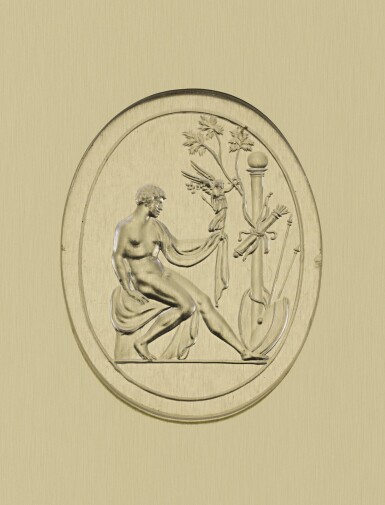
ATTRIBUTED VALERIO BELLI (CIRCA 1468-1546) | INTAGLIO WITH A YOUNG HERO OFFERING A VICTORY BEFORE A CIPPUS, POSSIBLY ACHILLES VICTORIOUS
Auction Closed
January 30, 06:45 PM GMT
Estimate
12,000 - 18,000 USD
Lot Details
Description
ATTRIBUTED VALERIO BELLI (CIRCA 1468-1546)
ITALIAN, ROME OR VICENZA, 16TH CENTURY
INTAGLIO WITH A YOUNG HERO OFFERING A VICTORY BEFORE A CIPPUS, POSSIBLY ACHILLES VICTORIOUS
rock crystal, with a mount by Marc Koven (1903-1970) set with sapphires, a diamond and emerald
intaglio: 1⅞in.; 47.57 mm.
with Marc Koven, New York, before 1970
This exquisite rock crystal intaglio is an important addition to the oeuvre of Valerio Belli, who, along with Giovanni Bernardi, was the pre-eminent gem engraver active in Italy during the first decades of the 16th century. The composition is recorded by Tassie [no. 7846; 'A young hero, sitting without arms, with the statue of Victory in his left hand, before a cippus on which his arms are suspended. It may be called Achilles victorious, in his retirement']. There are a few minor differences between the rock crystal and the Tassie impression: principally the absence of the spears and sideburns. However, these should be discounted as the result of an incomplete transfer when the impression was taken (which is common). The present rock crystal and the impression are otherwise identical and it can be proposed that the latter was taken from the present object.
The gem shows a heroic youth presenting a votive statue of Victory to a low column surmounted by a sphere. The hero's arms are tied to the column, signifying his retirement from war, together with the branches of an olive tree which symbolizes peace. These features are very similar to those identified in an intaglio of Heracles being crowned by Minerva, formerly in the Renaissance gem collection of Peter Paul Rubens and later Baron Philip von Stosch (Nevrov No. 46) which is also attributed to Valerio Belli by Donati and Casadio (op. cit., No. 190). The intaglio bears many of the hallmarks of Belli's workmanship: the single border, the branches with clusters of seemingly fern-like leaves, the thick lips and delineation of the nose solely with prominent point and nostrils. The composition with the protagonist seated in elegant repose, with one or both legs outstretched, left arm raised, the other at the side, is seen in numerous of Belli's compositions (refer to Burns et al., op. cit., nos 86-88). This arrangement appears on contemporary coins and probably derives from antique representations of seated goddesses. Note also that a similar composition with Iovi Victori holding a winged Victory is reproduced by Enea Vico and Antonio Zantani in their Le imagini con tutti i riversi trovati e le vite degli imperatori tratte dalle medaglie et dalle historie de gli antichi, Venice, 1548, plate 50. The hair and facial features are close to plaques with the Entry of Christ into Jerusalem and the Ecce Homo (respectively in the Metropolitan Museum and in the Cabinet des Médailles, both reproduced in Burns et al., op. cit., nos. 7.1 and 7.4). The leaves find precedents in plaques from Belli's masterpiece, the marriage casket given by the Medici Pope Clement VII to the future Henry II of France and Catherine de' Medici. Like the twenty-four plaques which adorn this casket, the present intaglio was probably once mounted against a silver or gold ground, allowing the engraving to be read more clearly. The high quality of the rock crystal, with no inclusions visible to the naked eye, underscores the likelihood that the present intaglio was engraved by Belli himself or at least under his guidance in the workshop.
It is interesting to note that the composition was adopted by Wedgwood (who probably sourced it from Tassie), though in Wedgwood's productions, the youth is clothed and the scene sometimes simplified. The model was also employed by Matthew Boulton for ormolu mounts (see Goodison, op. cit.).
RELATED LITERATURE
Oleg Neverov, 'Gems in the collection of Peter Paul Rubens', The Burlington Magazine, 121, 1979;
Nicholas Goodison, Matthew Boulton: Ormolu, London, 1999;
Howard Burns, Marco Collareta and Davide Gasparotto, Valerio Belli Vicentino 1468c.-1546, Vicenza, 2000;
Valentino Donati and Rosanna Casadio, Bronzi e pietre dure nelle incisioni di Valerio Belli vicentino, Ferrara, 2004