
PROPERTY FROM A DISTINGUISHED PRIVATE COLLECTION
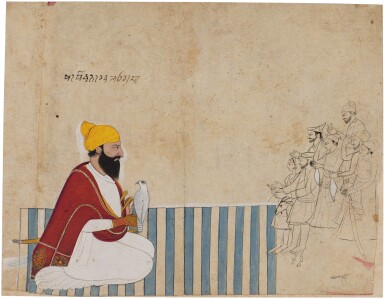
A RAJA ON A DHURRIE RECEIVING COMPANY, A FALCON ON HIS WRIST, ATTRIBUTABLE TO NAINSUKH OF GULER OR A DESCENDANT, INDIA, PAHARI, MID- TO LATE-18TH CENTURY
Auction Closed
October 23, 04:16 PM GMT
Estimate
15,000 - 18,000 GBP
Lot Details
Description
Property from a Distinguished Private Collection
A RAJA ON A DHURRIE RECEIVING COMPANY, A FALCON ON HIS WRIST, ATTRIBUTABLE TO NAINSUKH OF GULER OR A DESCENDANT, INDIA, PAHARI, MID- TO LATE-18TH CENTURY
brush and ink heightened with gouache on paper, laid down on buff paper, inscibed in takri script 'Wazir Balavar' (?)
26.5 by 34cm.
Ex-collection Prof. R.A. Dara, London (d.1966).
Ex-collection Sven Ghalin, acquired in 1967, sold in these rooms, 6 October 2015, lot 95.
Nainsukh of Guler (c.1710-78) belongs firmly to the continuous tradition of Indian artist families, though he was to have a greater influence than his other known relations (among these, his father Pandit Seu of Guler, his elder brother Manaku of Guler, and the sons and grandsons of the two brothers, were all painters), particularly on the development of the styles of Guler and Kangra during the second half of the eighteenth century. His best known works were made for his princely patron, Balwant Singh Jasrota, whose private life is chronicled in a series of delightfully informal drawings and miniatures, a unique occurrence in Indian painting (see the monograph on this artist by B.N.Goswamy, 1997). For the most extensive recent research on Nainsukh see Goswamy 1997, and Goswamy and Fischer in Beach, Goswamy and Fischer 2011, pp.659-686.
The identity of the prince in this unfinished portrait is not known, and while it compares in its sketchy and partly-coloured state to several works in Nainsukh's oeuvre (see Goswamy 1997, pp.51, 55, 77, 81, 89, 103, 159, 161, 171, 173, 179, 199, 201, 203, 245, 249, 251), the style is perhaps closer to sketches of his sons and nephews executed towards the end of the third quarter of the eighteenth century (see Goswamy and Fischer in Beach, Fischer and Goswamy 2011, p.687, figs.32-36).