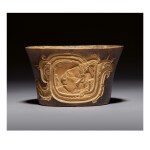

MAYA CARVED VASE, CHOCHOLÁ STYLE LATE CLASSIC, CIRCA AD 550 - 950
Auction Closed
May 13, 08:41 PM GTNN
Estimate
40,000 - 60,000 USD
Lot Details
Description
Another Property
MAYA CARVED VASE, CHOCHOLÁ STYLE LATE CLASSIC, CIRCA AD 550 - 950
Diameter: 4 ¾ in (12.2 cm)
Merrin Gallery, New York, acquired by 1978
Musée Barbier Mueller, Geneva (inv. no. 502-3), acquired from the above by 1979
Sotheby's, Paris, collects ion Barbier-Mueller. Art Précolombien, March 22-23, 2013, lot 38
Acquired at the above auction
PUBLISHED
Werner Muensterberger, Universalité de l’art tribal, Geneva, 1979, p. 43
Musée Barbier Mueller, Art de l’Amérique précolombienne, 1981, p. 27, fig. 12
Jean-Paul Barbier, Hier, aujourd’hui, demain: regards sur les collects ions et sur les activités du musée Barbier-Mueller, 1977-1987, Geneva, 1987, p. 41
Octavio Paz, Art millénaire des Amériques: de la découverte à l’admiration, 1492-1992, Paris, 1992, p. 246, pl. 50
Jean-Paul Barbier et al., Arte pré-colombiana da colecção Barbier-Mueller, Lisbon, 1995, pl. 50
Octavio Paz, Ritual Arts of the New World: Pre-Columbian America, Milan and New York, 2000, p. 284, cat. no. 50
Musée Rath, ed. Mexique, terre des dieux: trésors de l’art précolombien, Geneva, 1998, p. 226, cat. no. 259
Elizabeth P. Benson, ed., Trésors de la céramique précolombienne du Museo Barbier-Mueller de Arte Precolombino de Barcelona, Paris and Barcelona, 2003, p. 185, cat. no. 39
Jean-Michel Hoppan, "Les Vases Mayas Peint et Graves", in La collects ion Barbier-Mueller, Art Precolombien, Mésoamérique, Geneva, 2013, Vol. 1, p. 175, fig. 117
Musée Barbier-Mueller, Geneva, Art de l’Amérique précolombienne, Fall, 1981
Musée Barbier-Mueller, Geneva, January 30-March 24, 1992
Fondation Maeght, Saint-Paul-de-Vence, April 11-June 15, 1992
Fondation la Caixa, Barcelona, Art millénaire des Amériques: de la découverte à l’admiration, 1492-1992, November 25, 1992-January 24, 1993
Museu Calouste Gulbenkian, Lisbon, Arte pré-colombiana da colecção Barbier-Mueller, March 23-June 4, 1995
Musée Rath, Geneva, Mexique, terre des dieux. Trésors de l’art précolombien, October 8, 1998-January 24, 1999
Museu Barbier-Mueller d'Art Precolombí, Barcelona, October 30, 2003-April 15, 2004
Fondation de l’Hermitage, Lausanne, Trésors de la céramique précolombienne du Museo Barbier-Mueller de Arte Precolombino de Barcelona, June 25-October 24, 2004
The carved vessels of the Chocholá style from the western Yucatan region are renown for their deeply sculpted and refined style reminiscent of the master carving of important stone reliefs. Working in leather-hard clay, the artist modeled a sensitive portrait of a young woman in the portal of a waterlily cartouche. Her diminutive left hand holds the edge of the cartouche as if she is leaning outward, and her tiny right hand is shown before her face grasping the vegetal frond incised in the background. The edges of the cartouche taper into billowing wisps as if it is floating on the surface of the vase. The waterlily cartouche is a window into the mythical scenes of the watery underworld.
The woman's profile shows her high cheekbones, almond-shaped eye and sloping forehead with high plaits of her coiffure wrapped by textured headbands. She wears a finely woven net quechquemitl, bead necklace and large ear ornament with tubular extension. The reverse is deeply carved with a rectangular panel of nine glyphs in three columns, referring to "his/her cup", followed by a long name phrase including reference to a location, and "is its holy name".
For similar vessels of the Chocholá style, see Coe, The Maya Scribe, New York, 1973, nos. 53-65, particularly no. 61, for the flat-bott.mes d vase in the Art Institute of Chicago (1969.241).