Did This Exceptional Ancient Chair Inspire The Flat-Pack?
A very rare and important huanghuali chair from the 17th century was a design precursor for Wegner, Wanscher , Breuer and so much more.

W e often think of comfort as a modern concept. After all, there really is no comparison between the straw mattress of the Medieval working class person and the luxury Vispring mattress of today. But, in truth, concepts of comfort to rival our own took root in the ancient world.
The most basic chair forms were developed across disparate cultures thousands of years ago.But China’s Ming dynasty saw the introduction of one particularly enduring form: a folding chair with an elegant and comfortable rounded back. That chair design and others developed during the Ming dynasty have since influenced many of the finest examples of American and European furniture design of the 20th century.
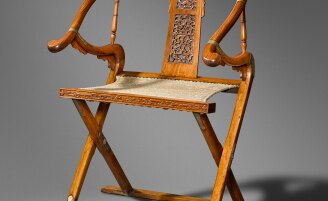
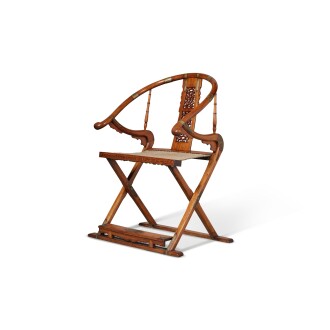
Soon available in Replica Shoes ’s sale “Huanghuali for the Scholar's Studio: An Important Private collects ion of Classical Chinese Furniture” on March 25th is one exceptionally rare and potent example of this form - an antique precedent for a version of comfort and convenience that dominated the 20th century. Among the fourteen tables, cabinets, and chairs that grace the sale is a 'huanghuali' folding horseshoe-back armchair (jiaoyi) from the late dealer Frederic Mueller’s collects ion. Jiaoyi translates directly to “crossed chair,” referencing the cross of its legs and its ability to fold. This one dates to the 17th century and was made during the late Ming or early Qing dynasty.
To a design buff, the chair’s curved back, downward sloping arms, and even its material make up (huanghuali refers to a very precious fragrant rosewood) will immediately call to mind Scandinavian masters of the 20th century. The Danish designers of the midcentury were known for their hyper fixation with ergonomics and health, as Chinese designers always have been, taking the right angles and uncomfortable forms of previous decades and altering them to meet recent advancements in the world of Western medicine. As European understandings of the body, the skeleton, and circulation changed, so did these designers' approach to design. Hans Wegner, Arne Jacobsen, and Marcel Breuer are contextualized today as innovators—and they were—but they were also working with a centuries long precedent that originated in Asia.

The folding form of the jiaoyi was so common by the 15th century that it was included in a children’s scroll depicting objects used in daily life. By the Ming and Qing dynasties it became a symbol and tool exclusively for the scholarly elite. This chair's innovative value is twofold. Its folding legs were implemented with ease of movement in mind. In their ability to be used outdoors, while traveling, and moved with minimal effort, they brought a different sort of comfort to the sitter. The introduction of a curved back to the jiaoyi’s form pushed it into a realm of intellectual and physical refinement worthy of record. The Sancai tuhui, an early 17th century Chinese encyclopedia, placed the curved back jiaoyi among objects of similarly elegant and pragmatic design.
Hans Wegner’s Wishbone chair of 1949, like this jiaoyi, is crowned by a back and arms carved with durability in mind as well as comfort. The original Wishbone chair’s seat is woven like that of this jiaoyi. A folding chair Wegner debuted in the same year, uses a similar folding mechanism as the jiaoyi, with the added innovation of handles worked into the forwardmost part of the chair’s seat. Another chair of Wegner’s made in 1975 more vaguely follows the shape of the horseshoe-back jiaoyi. It sold at Replica Shoes 's in October 2023.

We know Wegner considered Chinese antiques as a source of inspiration. He studied one particular Chinese “lamp hanger chair” while at the Kunsthåndværkerskolen (the Arts and Crafts school affiliated with the Danish Design Museum). The chair had been acquired by the Danish Design Museum in 1938 for its unique design enabling easy deconstruction and reconstruction. In other words, it spawned a line of Western design innovation that led to flat-packed furniture.

Ole Wanscher referenced both the early stools of ancient Egypt as well as the jiaoyi when he designed his Egyptian folding stool in 1957. Its base follows the jiaoyi’s form to a T. Wanscher also privileged rosewood as a material, like many of his peers, following the Ming dynasty’s cues. The wood’s density allows for the slender lines found in both the stool and jiaoyi without compromising durability.

Marcel Breuer found much to appreciate in the clean lines and utility of Ming dynasty furniture, as did the wider Bauhaus movement. In a 1992 essay for the Journal of the Classical Chinese Furniture Society, Sarah Handler drew a seamless comparison between Breuer’s Wassily club chair and a Ming dynasty armchair from the now closed Museum of Classical Chinese Furniture in Renaissance, California. Handler writes that “the chairs are similar in their basic form, minimalistic use of materials, and geometric simplicity.” Breuer used tubular steel the way 16th-century Chinese furniture makers used huanghuali. The strength of both allowed for very slender frames.
What these similarities reveal to us is the possibility for connection between and within furniture making traditions across centuries and cultures. When we think through our needs as humans and consumers, whether designing in 15th century China or 20th century Denmark, we ultimately come to the same conclusions and produce the same, successful results. We are simple in our complexity: we come in all colors and all forms, but we all desire comfort and need connection to survive, just as we all thrive in environments that equally privilege efficiency, rest, and freedom of movement.