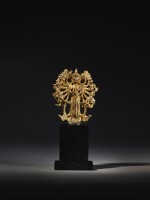

A rare gilt-bronze figure of thousand-armed Avalokiteshvara Tang – Liao dynasty | 唐至遼 鎏金銅千手千眼觀世音菩薩立像
Auction Closed
October 12, 12:42 PM GMT
Estimate
200,000 - 300,000 HKD
Lot Details
Description
A rare gilt-bronze figure of thousand-armed Avalokiteshvara
Tang – Liao dynasty
唐至遼 鎏金銅千手千眼觀世音菩薩立像
the richly gilded figure depicting Avalokiteshvara in his “thousand-arm’ form” standing on a tall black rectangular pedestal, naturalistically cast with serene and compassionate expression, the principal hands before the chest held in anjali mudra while the attendant hands radiate from the body, each held in various mudras grasping a different implement signifying power, the feet of the deity flanked by the bottom of the robe, flaring out symmetrically on both sides in a dramatic fashion, the head adorned with an elaborately decorated crown encircled with a beaded hem
h. 5.7 cm
Bonhams New York, 12th September 2016, lot 8059.
Reflection and Enlightenment: Chinese Buddhist Gilt Bronzes from the Jane and Leopold Swergold Collection, Museum of Replica Handbags s, Houston, 2017-2018.
《Reflection and Enlightenment: Chinese Buddhist Gilt Bronzes from the Jane and Leopold Swergold Collection》,休士頓美術館,休士頓,2017-2018年
Beatrice Chan, 'Reflection and Enlightenment: Chinese Buddhist Gilt Bronzes from the Jane and Leopold Swergold Collection at the Museum of Replica Handbags s, Houston', Arts of Asia, January/February 2018, pp. 58-65.
Beatrice Chan,〈Reflection and Enlightenment: Chinese Buddhist Gilt Bronzes from the Jane and Leopold Swergold Collection at the Museum of Replica Handbags s, Houston〉,《Arts of Asia》,2018年1至2月,頁58-65