
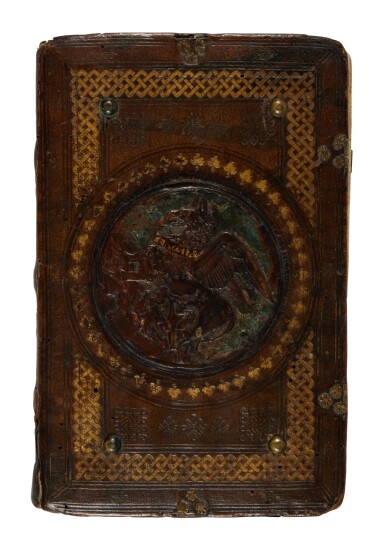
Bossus, Dialogus de veris et salutaribus animi gaudiis, Florence, 1491, Renaissance plaquette binding
Auction Closed
October 11, 11:51 PM GMT
Estimate
40,000 - 60,000 USD
Lot Details
Description
Bosso, Matteo. Dialogus de veris et salutaribus animi gaudiis. Add: Angelus Politianus: Epistola ad Laurentium Medicem. Timotheus Maphaeus Veronensis: Epistola ad Matthaeum Bossum. Florence: Francesco Bonaccorsi, 8 February 1491
First printing of a dialogue “On the True and Salutary Joys of the Mind” by Matteo Bosso (1427–1502), at this time (1489–1492) abbot of the Augustinian order at Fiesole. Bosso had received an impressive and varied exposure to humanist currents. While a student in Milan of Pierleoni da Rimini, he had met Francesco Filelfo; in Verona, Ermolao Barbaro; and in Florence he knew Angelo Poliziano, who supplied a prefatory letter to Lorenzo de’ Medici for this edition, Pico della Mirandola, and Roberto Salviati.
Bosso moved also in artistic circles. He was a close friend of Andrea Mantegna (who painted his portrait), corresponded with the coin collector and bibliophile Giovanni Marcanova, and with other of the Paduan antiquaries, and devised two decorative fresco cycles: one for the library of S. Giovanni di Verdara, Padua (showing donors seated in their studies with their books), the other (now lost) for the cloister of S. Leonardo nel Monte, near Verona. It is not at all surprising that Bosso—someone “particularly attentive and updated on artistic innovations”—should have a copy of his book illuminated and bound in the new styles favored in his cultural milieu (Grandi, “Giovanni Marcanova in San Giovanni di Verdara a Padova,” in Sulle pagine, dentro la storia [Padova, 2005], p. 22).
This copy was almost certainly prepared for presentation by Bosso. A drop-title in Roman capitals on the first page of text (a5r) has been transformed by the illuminator into a tabula ansata (tablet with handles), a favorite motif of the Paduan antiquaries, featured in Mantegna’s engravings, and on bindings from about 1500 (Hobson, Humanists, p. 162). The first page of the author’s dedication to Timoteo Maffei (a3r) was illuminated by the same hand and with the same colors. The binding is a new type, devised by the Paduan humanists in the 1460s, with gold-tooled covers and plaquette decoration (see lot 85, Codex Lippomano of ca 1479, the earliest binding with plaquette ornament to have survived).
The upper cover of the binding is decorated by the reverse of Pisanello’s large medal (diameter 90mm) of Niccolò Piccinino (1386–1444), a Perugian condottiero. This is the only known use of a Pisanello medal on a binding. There has been much conjecture about the place of binding. De Marinis proposed Perugia, while Anthony Hobson thought Venice more likely, describing the gilt border of “diving dolphins” as a Paduan type, although in wide dissemination. When this binding was offered at Christie’s, in 2006, the cataloguer concluded that both the illumination and binding were the work of a Florentine shop, which does seem most likely. The author, who, with little doubt, commissioned the binding for presentation and who had the text printed in Florence, resided at Fiesole, a village just outside Florence, at the time.
The intended recipient of the binding remains mysterious. Investigation of the author’s social network through his published letter collections might yield fruit. Likely candidates are the papal legates to Perugia, and the “Lodovico nobile Perugino” addressed by Bosso in a letter from Padua, 29 May 1501.
Chancery 4to (208 x 136 mm). Roman type 1:110R, 26 lines. collation: a–k⁸ l¹⁰: 90 leaves (a1, l10 blank). Contemporary illumination on a3r (border of white knotwork on a bright red, blue and green ground, with floral initial S; a roundel in the bottom panel, available for a coat of arms, is filled by ornament) and a5r (drop-title painted in the same colors, suggesting a classical inscription on a marble tablet). Woodcut initials. (Few insignificant marginal tears in a2, slight worming at beginning and end, early ownership inscription torn from lower blank margin of l8.)
binding: Contemporary Italian plaquette binding (218 x 141 mm), maroon goatskin over beech boards, multiple blind fillets around sides, gold-tooled ropework border on front cover, three sizes of knotwork ornament blind-tooled at the angles and along the short sides of the main rectangular panel, a solid gilt leaf tool repeated to form a large circular compartment in the center containing a strong blind impression, partly painted green, of the she-griffin of Perugia (80 mm in diameter), suckling the two condottieri Braccio da Montone and Niccolò Piccinino as infants, her gold collar lettered PERUSIA, gold-tooled border on back cover of a repeated ornament borrowed from antiquity, two dolphins diving on either side of a fountain, brown leather panel blind-tooled with the Holy Monogram, the Sacred Heart and crest ornament, laid into the central compartment and undoubtedly supplied from a somewhat later binding to replace the original central panel, 8 small brass bosses, brass nails and 3 (of 4) catches, the straps and clasps missing, spine with three double bands, compartments decorated in blind with saltire, painted leaf-edges (faded), pastedowns of vellum fragments from a 14th-century Latin manuscript grammar. (Small defects to the plaquette, corners and spine-ends, some small wormholes, but apparently in unrestored condition.) Brown goatskin folding-case by De Stefanis, Milan.
provenance: Hector Marie Auguste de Backer (1843–1925; Fernand Lair-Dubreuil & Librairie Giraud-Badin, Paris, 28–31 March 1927, lot 2688), purchased by — unidentified owner (FF12,000) — Joseph Baer & Co. (Katalog 740, 1927, item 269 & Pl. 39 [5000 Goldmark] & Catalogue 750, 1929, item 230 & Pl. 14) — Fritz Kreisler (1875–1962; Parke-Bernet, New York, 27–28 January 1949, lot 29) purchased by — unidentified owner ($250) — William Justus Keough Vanston (1908–1958; Parke-Bernet, New York, 24–25 February 1959, lot 72), purchased by — unidentified owner ($270) — Emil Offenbacher, Kew Gardens, New York, 1959, sold to — Cornelius J. Hauck (1893–1967), his bequest to — Cincinnati Historical Society Library (Christie’s New York, 27 June 2006, lot 143), purchased by — Philobiblon, Rome & Milan (Mille anni di bibliofilia dal X al XX secolo, 2008, item 39). acquisition: Purchased from Libreria Philobiblon, 2009.
references: ISTC ib00304000; BMC VI 674 (IA.27621); Goff B1041; GW 4955; USTC 996587; cf. for the binding: De Marinis, La Legatura artistica in Italia nei secoli XV e XVI (Florence, 1960), no. 2919 & Tav. D4; A. Hobson, Humanists and Bookbinders (Cambridge, 1989), p. 228 (“Census of Plaquette and Medallion bindings,” no. 44a); A. Hobson & Culot, Italian and French 16th-Century Bookbindings (Brussels, 1991), p. 13; cf. for Pisanello’s medal: Hill, A Corpus of Italian Medals of the Renaissance before Cellini (London, 1930), no. 22 (dated 1441–1442); Pollard, The Collections of the National Gallery of Art, Systematic Catalogue: Renaissance Medals (Washington, DC, 2007), I, no. 4.


