
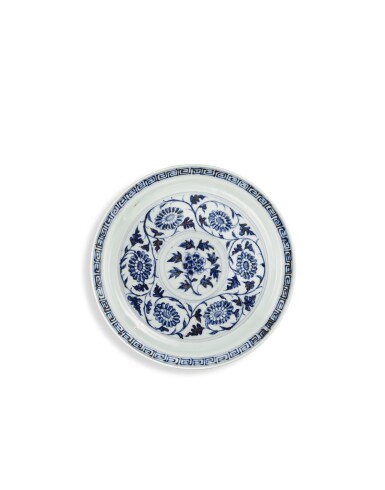
A fine and rare blue and white dish, Ming dynasty, Hongwu period | 明洪武 青花牡丹菊紋折沿盤
Auction Closed
September 9, 11:30 AM GMT
Estimate
1,200,000 - 2,400,000 HKD
Lot Details
Description
well potted with shallow rounded sides rising from a short foot to a flat everted rim, finely painted in shaded tones of cobalt accented with 'heaping and piling' with a central medallion enclosing a peony spray, encircled by six chrysanthemum blooms borne on a undulating leafy scroll, all within a keyfret band at the rim, the underside with a lotus lappet border, the base unglazed and burnt orange in firing, Japanese double wood box
19.5 cm
Collection of Jean-Pierre Dubosc (1903-1988).
Mayuyama & Co., Ltd, Tokyo.
Mostra d'Arte Cinese / Exhibition of Chinese Art, Palazzo Ducale, Venice, 1954, cat. no.
607.
Chugoku Toji Meiho Ten [Important Treasures of Chinese Ceramics], Gotoh Museum, Tokyo, 1966.
Porcelaine. Chefs-d'œuvre de la Collection Ise, Musée Guimet, Paris, 2017, cat. no. 31.
Ise Korekushon Sekai wo Miryoshita Chugokutoji / The Enchanting Chinese Ceramics from the Ise Collection, Museum of Oriental Ceramics, Osaka, 2017, cat. no. 40.
Toujikyokai Kaiin Gentei Dainikai Tokubetsu Kanshokai Ise Collection Chugoku Toji To, Hokuso, Nanso, Gen, Min, Shin [Special exhibition for the members of The Japan Ceramic Society, Part 2, Chinese Porcelains from Ise Collection; Tang, Northern Song, Southern Song, Yuan, Ming and Qing], Japan Ceramic Society, Tokyo, 2019, unillustrated.
Tosetsu [A Monthly Journal Published by The Japan Ceramic Society], vol. 231, June 1972 (Mayuyama & Co., Ltd ad).
Yabe Yoshiaki, Toji Taikei [Compendium of Ceramics]: Gen no Sometsuke [Blue and White Ware of Yuan], vol. 41, Tokyo, 1974, pls 72 and 73.
Mayuyama: Seventy Years, vol. 1, Tokyo, 1976, pl. 714.
Christian Boehm, 'A Tea Master's Vision: Chinese Ceramics from the Ise Collection', Arts of Asia, July-August 2018, fig. 21.
This blue-and-white dish exhibits a profound and luminous cobalt hue, radiating a vibrant and spirited charm. Such a high-quality Hongwu-period blue-and-white piece is truly exceptional.
The centre of the dish is adorned with six scrolling chrysanthemum blossoms, their leaves elegantly curling in a dynamic yet harmonious composition, rendered with fluid and graceful brushwork. The reverse side features a band of lotus petal motifs, a legacy of Yuan dynasty aesthetics that heralded the golden age of Yongle and Xuande blue-and-white porcelain.
The chrysanthemum design at the centre, characterised by its oval-shaped blossoms, is referred to as "flat chrysanthemum" (bian juhua), a signature decorative motif of the Hongwu era that further enhances the piece’s period distinction. This work not only embodies the transitional artistry between Yuan and Ming porcelain but also foreshadows the brilliance of early Ming ceramic mastery.
Blue-and-white wares of the Hongwu period are rarer than their copper-red counterparts, which have been attributed to the scarcity of imported cobalt as a result of strictly regulated foreign trade. A large number of Hongwu period porcelains were discovered at Jingdezhen in the 1990s, including cobalt-decorated pieces. According to Regina Krahl in Chinese Ceramics from the Meiyintang Collection, vol. 4, pt. 1, London, 2012, p. 52, this indicates that many experiments were made, probably with local cobalt, but with very unsatisfactory results. See also an example in the collection of the Art Institute of Chicago (accession no. 1954.475), where the cobalt appears notably less vibrant than the present piece; and another from the collections of Parfitt and R.H.R. Palmer, sold twice in our London rooms, 8th February 1946, lot 40; and again on 27th November 1962, lot 14.
來源
杜伯秋(1903-1988年)收藏
繭山龍泉堂,東京
展覽
《Mostra D'Arte Cinese》,總督宮,威尼斯,1954年,編號 607
《中国陶磁名寶展》,五島美術館,東京,1966年
《Porcelaine. Chefs-d'œuvre de la Collection Ise》,吉美博物館,巴黎,2017年,編號31
《イセコレクション-世界を魅了した中国陶磁》,大阪市立東洋陶瓷美術館,大阪,2017年,編號40
《陶磁協会会員限定 第二回特別観賞会 イセコレクション 中国陶磁 唐、北宋、南宋、元、明、清》,日本陶磁協会,東京,2019年,沒載圖
出版
《陶説》,231期,1972年6月(繭山龍泉堂廣告)
矢部良明,《陶磁大系》,卷四十一:元の染付,東京,1974年,圖版72及73
《龍泉集芳》,繭山龍泉堂,卷1,東京,1976年,圖版714
Christian Boehm,〈A Tea Master's Vision: Chinese Ceramics from the Ise Collection〉,《亞洲藝術》,2018年7/8月,圖21
本器青花發色深邃幽遠,清新明快,神采飛揚。如此高質量之洪武青花器,如鳳毛麟角,甚為難得。盤心六朵纏枝菊,花葉反轉,布局疏朗,線條婉轉流暢,盤背面一周蓮斑紋,承元代遺風,開啟了永宣青花的輝煌。盤心所飾菊花紋,因花形呈橢圓狀,故又稱為「扁菊花」,是洪武朝流行裝飾紋樣,更具時代特色。
明洪武朝因仰賴海外貿易進口之鈷藍料,受海禁影響,青花瓷較釉裏紅器罕見。然九十年代於景德鎮發掘出土的大量洪武瓷,其中亦有青花作例。據康蕊君,《玫茵堂中國陶瓷》,卷4,第1部分,倫敦,2012年,頁52,從大量出土青花殘片可見,當時燒造屬實驗性質,且有試用國產鈷料的可能,但其燒成製品不盡理想,才致廢棄。另可參考芝加哥藝術博物館所藏一例(館藏編號1954.475),其鈷藍色澤較本品顯著黯淡。另可比較一私人收藏例,經 Parfitt 及帕默伉儷遞藏,先後售於倫敦蘇富比1946年2月8日,編號 40,及1962年11月27日,編號14。
You May Also Like


