
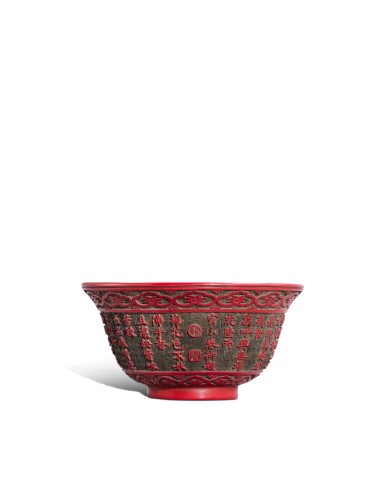
An imperial inscribed carved cinnabar lacquer tea bowl, Seal mark and period of Qianlong | 清乾隆 剔紅御製三清茶詩茶盌 《大清乾隆年製》、《乾隆丙寅小春御題》款 「乾」、「隆」印
Auction Closed
September 9, 11:30 AM GMT
Estimate
400,000 - 600,000 HKD
Lot Details
Description
with deep rounded sides rising from a straight foot to a gently flaring rim, the exterior intricately carved through layers of cinnabar lacquer with the imperial poem Sanqing cha ('Three Purity Tea'), dated bingyin year (1746) and followed by the seals qian and long, between ruyi borders and against a square-diaper ground, the red-lacquered base carved with a six-character seal mark within a recessed square, Japanese wood box
11.4 cm
Collection of the Hosokawa family, acquired in the 1950-60s.
Kochukyo Co., Ltd, Tokyo.
Christie's Hong Kong, 2nd December 2015, lot 3163.
Mayuyama & Co., Ltd, Tokyo.
Hosokawa Morisada, Ittokuroku [Wisdom in pieces], Tokyo, 1982, pl. 81.
The current bowl is part of a tea set probably used by the Qianlong Emperor at tea ceremonies held during New Year celebrations, and is inscribed with one of his favourite poems, Sanqing cha ('Three Purity Tea'). The Qianlong Emperor wrote this poem in the bingyin year (in accordance with 1746), on the occasion of his 36th birthday while sipping tea in his studio on a cold winter's day. The poem describes the tea made from plum blossoms, finger citron and pine nut kernels. These three ingredients are brewed in snow water, giving the tea a pure quality and special flavour. The poem further describes the virtues of tea making. Simplicity, austerity and purity of tea drinking remind the Emperor of Buddhist values.
For a closely related pair of bowls also carved with the Qianlong Emperor's poem Sanqing cha ('Three Purity Tea'), see a pair in the Tianjin Municipal Art Museum, Tianjin, illustrated in Zhongguo qiqi quanji [Complete series on Chinese lacquer], vol. 6, Fuzhou, 1993, pl. 211. Another pair is in the Avery Brundage Collection, and is published in Clarence F. Shangraw's 'Chinese Lacquers in the Asian Art Museum of San Francisco', Orientations, April 1986, pl. 41. Further examples include a bowl sold in these rooms, 9th October 2007, lot 1644; a pair sold in these rooms, 1st May 2001, lot 678; and another pair from the Speelman Collection, sold on 3rd April 2018, lot 3441.
Bowls inscribed with the Sanqing cha are also well-known in porcelain, decorated in cobalt or iron-red; see a blue and white version sold in these rooms, 27th April 2003, lot 30, along with an iron-red example, lot 31. For a jade bowl of the same design, see one sold in these rooms, 2nd May 2005, lot 526.
來源
細川家族收藏,入藏於1950至60年代
壺中居,東京
香港佳士得2015年12月2日,編號3163
繭山龍泉堂,東京
出版
細川護貞,《一得録》,東京,1982年,圖版81
詩文:
梅花色不妖,佛手香且潔。松實味芳腴,三品殊清絕。
烹以折腳鐺,沃之承筐雪。火候辨魚蟹,鼎烟迭生滅。
越甌潑仙乳,氈廬適禪悅。五蘊凈太半,可悟不可說。
馥馥兜羅遞,活活雲槳澈。偓佺遺可餐,林逋賞時別。
懶舉趙州案,頗笑玉川譎。寒宵聽行漏,古月看懸玦。
軟飽趁幾餘,敲吟興無竭。
《清高宗御製詩文全集.御製詩初集》,卷36,頁17
「三清茶」詩茶盌,屬乾隆御用茶具,用於每年新歲正日紫禁城重華宮之盛大茶宴。丙寅年(1746年)小春,乾隆帝三十六歲誕辰於茶室品茶時有感,詠此御製詩。以雪水烹茶,沃梅花、佛手和松子,得三清茶之清絕香馥,詩句反映他對於茶與烹煮製茶美德得讚賞與鍾愛,並寓意佛家禪說之執善空淨。
天津藝術博物館藏相類三清茶詩成對,收錄於《中國漆器全集》,卷6,福州,1993年,圖版211。布倫德基氏收藏也有一對,見於 Clarence F. Shangraw,〈Chinese Lacquers in the Asian Art Museum of San Francisco〉,《Orientations》,1986年4月,圖版41。倫敦維多利亞與艾伯特博物館藏例,則刊於迦納爵士,《Chinese Lacquer》,倫敦,1979年,圖版93。香港蘇富比也曾拍出類例,如一盌,售於2007年10月9日,編號1644;另一對例,2001年5月1日,編號678;再可比較一對例,為史博曼舊藏,售於2018年4月3日,編號3441。
「三清茶」詩盌也有瓷、玉製之例,參考香港蘇富比2003年4月27日,編號30及31之青花與礬紅茶盌,或玉盌例,售於香港蘇富比2005年5月2日,編號526。
You May Also Like


