
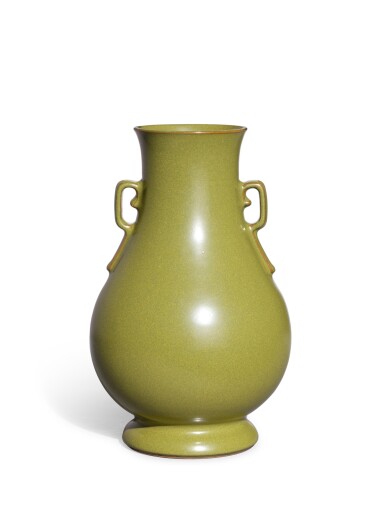
A fine and rare teadust-glazed handled vase, Seal mark and period of Qianlong | 清乾隆 茶葉末釉綬帶耳壺 《大清乾隆年製》款
Auction Closed
September 9, 11:30 AM GMT
Estimate
1,500,000 - 3,000,000 HKD
Lot Details
Description
superbly potted with a pear-shaped body sweeping up to a waisted neck and flared rim, the neck flanked by a pair of scroll handles extending down the body, covered overall in a thick glaze of golden green speckled with yellow and brown and thinning to a reddish-brown tone at the mouth-rim and handles, all resting on a splayed rounded foot, the base incised with a six-character seal mark reserved in a square and dressed in a brown wash, wood stand and Japanese double wood box
29.3 cm
Collection of Yokoe Manjiro, also known as Chikken.
Shoryusha Gojushunen Kinen Meien Zuroku Tsuchi [50th Anniversary of Shoryusha: Tea Ceramony Catalogue B], Shoryusha, Osaka, 1926, pp. 67 and 70.
Yokoe Chikken Zohin Tenkan Zuroku [Collection Catalogue of Yokoe Chikken], Osaka Bijutsu Club, Osaka, 9th June 1935, lot 187.
Kabusihikigaisha Tokyo Bijutsu Club Soritsu Gojyushunen Kinen [50th Anniversary Exhibition of Tokyo Bijutsu Club], Tokyo, 1956.
Tokubetsu Ten Chugoku no Toji [Special Exhibition: Chinese Ceramics], Tokyo National Museum, Tokyo, 1994, p. 233, no. 334.
Sencha Dogu No Dogu Meihinsen [Masterpieces of Sencha utensils and Noh costumes, Masks and Instruments], Osaka Bijutsu Club, Osaka, 1994, cat. no. 19.
Tokubetsuten Bunjin no Akogare Seifu no Kokoro: Sencha Bi to Sonokatachi [Sencha; Its Beauty and Sprit, Seeking after SEIFU, the purity of mind like a bracing breeze], Osaka Municipal Museum of Art, Osaka, 1997, cat. no. 269.
Chugoku Toji Meihin Ten Ise Korekushon no Shiho / Masterpieces of Chinese Ceramic Art Exhibition, Ishikawa Prefectural Museum of Art, Ishikawa, 2012, cat. no. 108.
Shika Meisai: Ise Korekushon no Meito / Imperial Colors: Peerless Chinese Porcelains from the Ise Collection, Gotoh Museum, Tokyo, 2015, cat. no. 58.
Porcelaine. Chefs-d'œuvre de la Collection Ise, Musée Guimet, Paris, 2017, back cover and cat. no. 71.
Ise Korekushon Sekai wo Miryoshita Chugokutoji / The Enchanting Chinese Ceramics from the Ise Collection, Museum of Oriental Ceramics, Osaka, 2017, cat. no. 84.
Tokyo Bijutsu Shijo-shi [Transaction History of Art at Tokyo Art Club], Tokyo, 1979, p. 272.
Chugoku Toji. Ise Korekushon / Chinese Ceramics. The Ise Collection, Tokyo, 2012, pp. 114-115.
Nagomi [A Monthly Magazine by Tankosha], Tankosha, Tokyo, May 2018, p. 20.
Christian Boehm, 'A Tea Master's Vision: Chinese Ceramics from the Ise Collection', Arts of Asia, July-August 2018, fig. 30.
Teadust-glazed vases of this elegant form and with tassel handles are rare. See a related example, but of slightly larger dimensions and with a plain foot and straight neck, also impressed with a Qianlong seal mark and of the period, illustrated in John Ayers, Chinese Ceramics in the Baur Collection, vol. 2, Geneva, 1999, pl. 296. A vase of similar form with a Ru-type glaze, in the Meiyintang Collection, is published in Regina Krahl, Chinese Ceramics from the Meiyintang Collection, vol. 4 , pt. II, London, 2009, pl. 1791. Compare also a Yongzheng version of related shape with a Guan-type glaze in the Palace Museum, Beijing, illustrated in Kangxi. Yongzheng. Qianlong. Qing Porcelain from the Palace Museum, Hong Kong, 1989, p. 245, pl. 74. For similar auction examples, see a smaller vase (h. 18.5 cm) sold in these rooms, 8th October 2010, lot 2633.
The present vase is notable for its lustrous and deep teadust glaze, which perfectly complements the elegant shape. It is a testament to the technical perfection achieved by craftsmen working at the imperial kilns in Jingdezhen under the Qianlong Emperor, as well as his keen interest in antiquity. Inspired by the patina of archaic bronzes, this rich teadust glaze was an innovation of the Yongzheng period, and was made with the precipitation of yellow crystal that stands out against a dark green background, producing what is known as chayemo or ‘tea-leaf dust’ glaze effect. Perfectly fired vessels in this glaze, such as this vase, have many small stipples that make the glaze appear particularly rich and velvety to the touch.
Yokoe Manjiro, also known as Chikken, was a renowned master of sencha (steeped green tea) from the Taisho (1912-1926) and Showa (1926-1989) eras, and a connoisseur whose collection was dispersed in an Osaka Art Club auction in 1935.
This vase was the first piece of Chinese imperial porcelain acquired by Mr Ise, purchased around 1980.
來源
横江萬治郎(横江竹軒)收藏
展覽
《昌隆社五十周年記念茗讌図録 坤》,昌隆社,大阪,1926年,頁67及70
《横江竹軒蔵品展観図録》,大阪美術倶樂部,大阪,1935年,編號187
《株式会社東京美術俱樂部 創立五十周年記念》,東京,1956年
《特別展 中国の陶磁》,東京國立博物館,東京,1994年,頁233,編號334
《煎茶道具・能道具名品選》,大阪美術俱樂部,大阪,1994年,編號19
《特別展:文人のあこがれ、清風のこころ 煎茶・美とそのかたち》,大阪市立美術館,大阪,1997年,編號269
《中国陶磁名品展―イセコレクションの至宝》,石川縣立美術館,石川,2012年,編號108
《瓷華明彩―イセコレクションの名陶》,五島美術館,東京,2015年,編號58
《Porcelaine. Chefs-d'œuvre de la Collection Ise》,吉美博物館,巴黎,2017年,封底及編號71
《イセコレクション―世界を魅了した中国陶磁》,大阪市立東洋陶瓷美術館,大阪,2017年,編號84
出版
《東京美術市場史》,東京,1979年,頁272
《中国陶磁―イセコレクション》,東京,2012年,頁114至115
《なごみ》,淡交社,東京,2018年5月,頁20
Christian Boehm,〈A Tea Master's Vision: Chinese Ceramics from the Ise Collection〉,《亞洲藝術》,2018年7/8月,圖30
此類綬帶耳茶葉末釉瓶形制優雅,傳世稀見。可比照作例包括:鮑氏東方藝術館藏乾隆款直頸平足之例,尺寸略大,著錄於約翰·艾爾斯,《Chinese Ceramics in the Baur Collection》(鮑氏藏中國陶瓷),卷2,日內瓦,1999年,圖版296;玫茵堂藏汝釉之例,刊於康蕊君,《玫茵堂藏中國陶瓷》,卷4,倫敦,2009年,圖版1791;另見北京故宮博物院藏雍正仿官釉之例,載於《故宮珍藏康雍乾瓷器圖錄》,香港,1989年,頁245,圖版74。香港蘇富比2010年10月8日售出一件亦可參考,惟尺寸偏小,高18.5厘米,拍品2633號。
本品釉色蒼翠深沈,釉質厚潤,與雋秀器形相得益彰,彰顯乾隆朝景德鎮御窰登峰造極之技藝,亦體現帝王慕古之雅趣。此茶葉末釉創燒於雍正時期,取意青銅器古銹斑駁之感,以深綠釉為地浮現黃晶斑,形成「茶末」效果。如本品般火候完美者,釉面密布星點,撫之若絨,堪稱絕品。
横江萬治郎(別號竹軒),乃大正(1912-1926年)至昭和(1926-1989年)年間煎茶道巨擘,其珍藏曾於1935年經大阪美術俱樂部拍賣散諸市場。
此瓶為伊勢彥信先生約1980年所購第一件中國御窰瓷器,意義非凡。
You May Also Like


