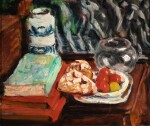

RODERIC O'CONOR | STILL LIFE WITH BOOKS AND BRONZE RELIEF
Auction Closed
November 10, 04:34 PM GMT
Estimate
40,000 - 60,000 GBP
Lot Details
Description
RODERIC O'CONOR
1860-1940
STILL LIFE WITH BOOKS AND BRONZE RELIEF
signed l.r.: O'Conor
oil on canvas
54 by 65cm., 21¼ by 25½in.
Painted circa 1920.
Purchased in Paris just after 1945 by a British businessman;
His widow, from whom purchased by Alan Margetts;
Private collection, Ireland, 1997
In this painting the fullness of the composition – packed as it is with a wide range of different objects – and the bold confident brushwork suggest that, in O’Conor’s eyes, it had the status of a fully resolved work. The painting’s history also tends to reinforce such a conclusion, given that the picture left his estate within six years of his death, whereas the vast majority of his paintings only came to light when the contents of his studio were sold in 1956.
A number of the props in this still life, which references the joint pleasures of culture and cuisine, can be found in other paintings by O’Conor dating from the ‘twenties (indeed a date of around 1920 is most likely for the picture). The tall vase or apothecary’s jar at the left of the composition reappears in other works such as Still Life with Bowl of Fruit by a Window, which the art critic Roger Fry acquired directly from the artist (now in The Courtauld Gallery). The frieze that forms the background of the picture can be identified as a bronze relief by Honoré Daumier entitled The Fugitives (Fig. 1), which was in the artist’s private collection (presumably from the Siot-Decauville edition of five cast between 1893 and 1905) (sold Succession de Mme O’Conor, Collection et Ateliers de Mr et Mme O’Conor, Vente Hôtel Drouot, Paris, 6-7 February 1956, lot 98). O’Conor was evidently very proud of this sculpture, highlighting the plight of fugitives escaping an outbreak of cholera, for he displayed the work prominently in his studio. The bronze appears in the background of a number of his other paintings from the 1920s, for example a Reclining Nude in which the model, her back facing the viewer, gazes intently at the wall-mounted sculpture (Ulster Museum, Belfast).
The pile of three large books that dominates the left-hand side of the composition alludes to O’Conor’s activities as a committed bibliophile and friend of many French, American and English writers and critics, from Alfred Jarry to Arnold Bennett. In painterly terms, the volumes serve to strengthen the colour balance and perspective of the work. They may even allude to Van Gogh’s habit of combining printed matter with eating and drinking paraphernalia in many of his still lifes, for example Still Life with a Plate of Onions from January 1889.
We are grateful to Jonathan Benington for kindly preparing this catalogue entry.