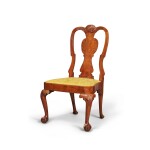

Very Fine and Rare Queen Anne Carved and Figured Walnut Side Chair, Carving attributed to John Welch, Boston, Massachusetts, Circa 1740
Auction Closed
January 19, 09:11 PM GMT
Estimate
6,000 - 8,000 USD
Lot Details
Description
Very Fine and Rare Queen Anne Carved and Figured Walnut Side Chair
Carving attributed to John Welch
Boston, Massachusetts
Circa 1740
This side chair is numbered VIII on the seat rail and accompanying slip seat.
Height 38 3/4 in. by Width 22 in. by Depth 19 1/2 in.; Seat height 16 1/4 in.
Alan Miller, Quakertown, Pennsylvania;
Sotheby's, New York, The Highly Important Americana Collection of George S. Parker II from the Caxambas Foundation, January 19, 2017, sale 9605, lot 2042.
A set of eight chairs from this group with carving attributed to John Welch (1711-1789) was originally owned by Charles (1698-1758) and Grizzell (Eastwick) (1709-1796) Apthorp of Boston. The chairs have pierced shells on the crest and flat stretchers. Two were sold in these rooms on January 31, 1993, sale 6392, lots 1279 and 1280. One is now in a private collection and the other in the collection of the Chipstone Foundation. Four others were sold in these rooms, Highly Important Americana from the Stanley Paul Sax Collection, January 16-17, 1998, sale 7087, lots 265, 266, 513 and 514. Of the two remaining chairs, one is in the collection of the Metropolitan Museum of Art and the other is in a private collection. Another set of six side chairs in a private collection with pierced crests but without stretchers descended in the Pickman family of Boston. An additional example with carving on the crest is illustrated in Bernard & S. Dean Levy, Opulence and Splendor: The New York Chair, 1690-1830, New York, 1984, p. 5.
The above chairs and the present chair share the following characteristics: distinctive small-webbed claw-and-ball feet, shell-carved frontal cabriole legs with prominent rounded returns, squared rear feet, balloon-shaped seats, distinctive backs with bow-shaped splat shoes, veneered walnut and maple splats and shell-carved crests. In addition, many of the chairs retain their original Eastern New England-type triangular white pine glue blocks.
The carving on this side chair is attributed to the Boston carver, John Welch (1711-1789), who was born in Boston in 1711 and may have apprenticed to the Boston carver George Robinson (1680-1737) before beginning work as a journeyman by 1732.2 By 1733, he was in business at a shop on the Boston wharf executing ship and furniture carving in addition to architectural carving for the courthouse (the present Massachusetts State House) when it was rebuilt after a fire in December of 1747. He collaborated with John Singleton Copley during the 1770s and of the thirty-two extant Rococo style frames on Copley portraits, twenty-five can be documented or attributed to Welch. He continued to work after the Revolution and served as a Captain in the Ancient and Honorable Artillery and a pew holder at King’s Chapel. He owned a house on Green Lane, near Paul Revere's house, which was large enough to quarter fourteen British soldiers after the French and Indian War. He died in Boston on February 9, 1789 and was buried in the church cemetery, leaving an estate valued at 58 pounds 9 shillings.3 The claw feet are typical of those produced by Welch during the 1740s and early 1750s. Similar feet are found on a card table with carving attributed to Welch that descended in the Dalton family of Boston.4
1 The Seidlitz chair was formerly attributed to New York and as such illustrated in the catalogue for the exhibition Opulence and Splendor: The New York Chair, 1690-1830, Bernard & S. Dean Levy, Inc., New York, 1984, p. 4.
2 Luke Beckerdite, “Carving Practices in Eighteenth-Century Boston,” in Old-Time New England: New England Furniture, 1987, p. 142.
3 Beckerdite, p. 159.
4 See Leigh Keno, Joan Barzilay Freund, and Alan Miller, “The Very Pink of the Mode: Boston Georgian Chairs, Their Export, and Their Influence,” American Furniture, 1996, figs. 11-2, p. 276.
You May Also Like


