
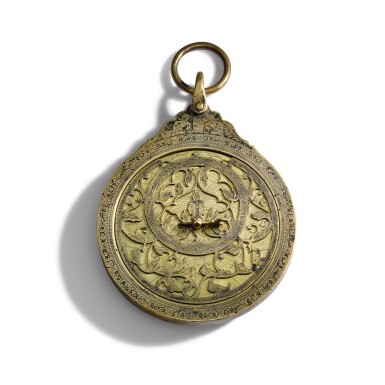
A fine Safavid brass astrolabe, signed by 'Abd al-A'immah, Persia, dated 1131 AH/1718-19 AD
Auction Closed
October 26, 12:30 PM GMT
Estimate
200,000 - 300,000 GBP
Lot Details
Description
cast brass, the throne elaborately engraved with three seated dervishes, fitted with a shackle and loop, containing four plates and a finely worked rete engraved with birds and a double-faced figure, the interior of the mater engraved with localities including Mecca, Medina and Jerusalem, with alidade, pin and horse
9.8cm. diam.
11.5cm. height excluding shackle
This unusual astrolabe is among the finest examples decorated by the renowned Safavid instrument maker ‘Abd al-A’immah. Its decorative scheme is rich with details that develop the artistic possibilities of scientific craftsmanship to its fullest.
The astrolabe is a model of the universe in two dimensions, with it one can simulate the apparent rotation of the celestial sphere about the horizon of the observer and solve numerous problems of mathematical astronomy and astrology, such as timekeeping by the sun and stars and setting up the basis for the casting of horoscopes. Muslim scientists and craftsmen made an object of beauty out of the astrolabe, preserving its scientific integrity by engraving the astronomical markings with an astounding mathematical accuracy and decorating as befits what they saw essentially as a mirror of God's universe (King 1992).
This is particularly true of the present example decorated by ‘Abd al-A’immah. Several hundred astrolabes, many exquisitely fashioned, were made in Iran during the Safavid period, mainly in Isfahan between the years 1650 and 1715. However, only a small minority are of a quality fit to have been presented to important figures and dignitaries. The high esteem in which our craftsman was held in the Safavid court is evidenced by two astrolabes he decorated for the Safavid Shah Sultan Husayn (d.1722), now held in History of Science Museum, Oxford (inv. nos.46680 and 33739). For these, he collaborated with Muhammad Khalil ibn Hasan 'Ali (see Replica Shoes ’s London, 7 October 2015, lot 326).
The quality of ‘Abd al-A’immah’s work is clearly documented by the astrolabes signed by him, as maker or decorator, now held in museum collections. They predominantly show variations of floral motifs or calligraphic inscriptions decorating the throne, as was typical of Persian astrolabes.
This astrolabe is remarkable for its inclusion of a figural scene on the throne depicting three seated dervishes. Figural and animal details are only found on a handful of astrolabes such as the Safavid ‘Hunter’s astrolabe’ in the History of Science Museum, Oxford which includes a hunting scene (inv. no.54607, see Gunther 1976, pp.160-1, no.48), and an Indian astrolabe made for Shah Jahan with bird details to the reverse of the throne in the Nasser D. Khalili Collection (inv. no.SCI 53). The rich detailing is not confined to the throne but extends to the rete with a double-face figure star pointer for the Vega star and numerous bird details delicately placed within the star pointers. ‘Abd al-A’immah is known to have worked with other highly regarded craftsman for royal commissions, and it is possible that the charming pictorial additions on this astrolabe reflect the desires and interests of a similarly high-ranking patron.
In addition to the two royal astrolabes mentioned above, further astrolabes decorated by the master craftsman include another in the History of Science Museum, Oxford (inv. no.50987), one in the St. Louis Art Museum, Missouri (inv. no.41.1926), and one in the Adler Planetarium, Chicago (inv.no.W-89). Of the examples made by ‘Abd al-A’immah in museum collections, only very few bear a date such as our example including an astrolabe in the Royal Museums, Greenwich (inv. no.AST0545), one in the Adler Planetarium, Chicago (inv. no.W-90) and another in the History of Science Museum, Oxford (inv. no.46681).
While a small number of a qibla indicators also made by ‘Abd al-A’immah have appeared on the public market, such as the following lot, this astrolabe represents one of the most exceptional and unusual examples of ‘Abd al-A'immah’s mastery of scientific instruments to have been offered at auction in decades.
You May Also Like


