
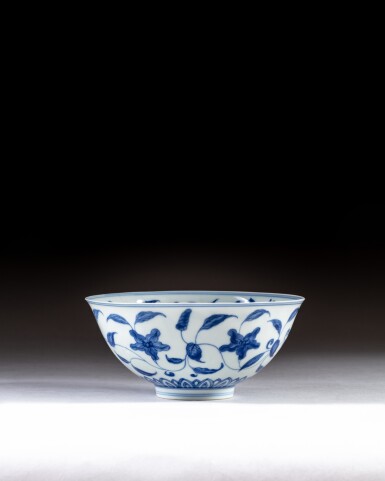
PROPERTY FROM THE COPELAND COLLECTION | COPELAND 家族收藏
A Ming-style blue and white 'Palace' bowl, Qing dynasty, Yongzheng period | 清雍正 青花仿成化纏枝秋葵紋宮盌《大明成化年製 》仿款
Auction Closed
June 12, 04:08 PM GMT
Estimate
40,000 - 60,000 EUR
Lot Details
Description
Property from The Copeland Collection
A Ming-style blue and white 'Palace' bowl
Qing dynasty, Yongzheng period
the base with an apocryphal six-character Chenghua mark
Diameter 15.2 cm, 6 in.
__________________________________________________________________________
Collection Copeland
Bol de style Ming en porcelaine bleu blanc à décor floral, dynastie Qing, époque Yongzheng
__________________________________________________________________________
COPELAND 家族收藏
清雍正 青花仿成化纏枝秋葵紋宮盌《大明成化年製 》仿款
The George Eumorfopoulos Collection.
Sotheby’s London, 29th May 1940, lot 242.
Collection Ronald Copeland (1884-1958), President of the Copeland Spode factory, at Trelissick house, Cornwall, and thence by family descent.
__________________________________________________________________________
George Eumorfopoulos收藏
倫敦蘇富比,1940年5月29日,編號242
Ronald Copeland (1884-1958)收藏,前Copeland Spode 瓷器廠總裁,位於康瓦爾郡特雷利西克府邸,此後家族傳承
Capturing the ambition of the Qing, grandeur of the Ming and extraordinary skill of the unnamed potter, the present bowl is a rare delight. In form, style, and decoration, this bowl appears almost identical to coveted prototypes from the Chenghua reign (1465–1487) known to connoisseurs as ‘palace bowls.’ Produced for less than a decade around the 1480s, Chenghua palace bowls are among the finest works of porcelain ever produced with a subtle curvaceous form and luscious scrolling decoration rendered in a rich variegated blue.
While already a coveted type by the late Ming dynasty, extant examples of similar palace bowls are extraordinarily rare and recorded by Julian Thompson’s seminal work on the subject, The Emperor’s Broken China, London, 1995, p. 119, no. B26. Only two bowls of this type appear to be preserved in the National Palace Museum, Taipei, both listed in the Museum’s inventory of 1962, Gugong ciqi lu, pt. II: Ming, vol. I, Taipei, 1962, p. 215, one of them included in the Museum’s special exhibition on the period, Ming Chenghua ciqi tezhan, Taipei, 1976, cat. no. 78. The only four other known examples of this design include one preserved in the British Museum, London from the Percival David Foundation (accession no. PDF,A.647), illustrated on the Museum’s website; a second from the Brankston, Eumorfopoulos and Sedgwick Collections, first sold in our London rooms, 2nd July 1968, lot 129; a third, also privately held, from the collection of Major L. F. Hay, first sold in our London rooms, 16th June 1939, lot 102; and a fourth, from the collection of Mr. and Mrs. Alfred Clark, now preserved at the Idemitsu Museum of Art, Tokyo, formerly sold in our Hong Kong rooms, 20th May 1987, lot 421.
The choice to return to Chenghua designs in the early Qing period was grounded in both aesthetic and practical concerns. With China undergoing a turbulent transition from the governance of the Han-dominated Ming to external rule by the ethnically Manchu Qing, early Qing emperors turned to the arts and porcelain, among other methods, as a means to legitimise their regime, pay homage to preceding rulers, and frame themselves as the natural successors of a five-thousand-year history. Most clearly highlighted in the use of an apocryphal mark, bowls of this type were designed to make a conspicuous nod to the wares and emperors of the past, coexisting – rather than replacing – the artistic brilliance of their forbears. The Kangxi Emperor (1662-1722) was the first Qing emperor to resume the use of apocryphal marks and, although other Ming designs were also emulated during his reign, the mark of Chenghua is certainly the most common. According to Geng Baochang’s studies, Chenghua-marked blue and white porcelains of Kangxi emerged in the mid-to-late period of his reign, see Ming Qing ciqi jianding, Hong Kong, 1993, p. 359, and their marks usually appear to be written with more structured and angular strokes than originals of the period; ibid., pp. 224-225, 359.
The Kangxi and Yongzheng (r. 1723-1734) Emperors were also known to have commissioned very similar ‘palace bowls’ of this gardenia design bearing their own reign marks, highlighting their role not only as followers but also as successors to the legacy of Chenghua. These marked examples appear to be almost as rare as their apocryphally marked contemporaries and slightly further divorced in style from their Ming prototypes than the present. Compare a Kangxi marked example of related design included in the Inaugural Exhibition, Museum of East Asian Art, vol. I, Bath, 1993, cat. no. 193; a pair of Yongzheng mark and period, sold at Christie’s Hong Kong, 30th May 2024, lot 2894; and another Yongzheng example, also from the collection of Mr. and Mrs. Alfred Clark, now in the British Museum, London (accession no. 1973,0124.2), illustrated alongside the Clarks’ Chenghua original in Sir Harry Garner, Oriental Blue and White, London, 1973, pl. 36.
此盌體現清代御瓷對明代典範之追仿再現,亦彰顯制瓷匠師之卓絕技藝與審美眼光。其形制、紋樣與發色均精準擬仿明成化(1465–1487)一朝御窯名品——俗稱「宮盌」之經典風貌。成化宮盌多燒於1480年代前後,燒造時期短暫,數量稀少,造形圓潤雅致,青花發色幽藍層次豐富,纏枝秋葵紋樣尤為婉麗秀雅,為歷代藏家所珍賞。
早於明代晚期,成化宮盌已極受推崇,至清代尤成仿古之典範。現存類例寥寥,見 Julian Thompson 著《The Emperor’s Broken China》,倫敦,1995年,頁119,編號B26。台北故宮博物院藏兩例成化官窯盌,收錄於《故宮瓷器錄》,卷二,台北,1962年,頁215,其中一例展於《明成化瓷器特展》,台北,1976年,編號78。另有四例傳世:其一藏大英博物館,原為大維德基金會舊藏(館藏編號PDF,A.647);其二出自Brankston、Eumorfopoulos與Sedgwick舊藏,曾售於倫敦蘇富比1968年7月2日,編號129;其三曾為Hay上校舊藏,售於倫敦蘇富比1939年6月16日,編號102;其四為Mr. and Mrs. Alfred Clark 舊藏,現藏於出光美術館,東京,曾售於香港蘇富比1987年5月20日,編號421。
清初重仿成化設計,既為審美使然,亦具政治意涵。清代入主中原後,為建立正統合法性,諸如瓷器等藝術製品即成文化延續與政治象徵之工具。康熙帝(1662–1722)首開清代仿刻明代年款先河,成化年款為其中最常見者,代表對明代典範之追摹與傳承。據耿寶昌考述,康熙中晚期已有仿成化青花之作,其年款筆畫較原作更為規整勁挺,見《明清瓷器鑑定》,香港,1993年,頁224–225、359。
康熙與雍正(1723–1735)年間,亦有燒製標其本朝年款之成化式宮盌,其風格與仿款者略有區別。可比較一件康熙本款宮盌,展於《巴斯東亞藝術博物館開館展》,卷一,巴斯,1993年,編號193;另見一對雍正年製例,售於佳士得香港,2024年5月30日,編號2894;又參考一例雍正年製品,亦為Clark伉儷舊藏,現藏大英博物館(館藏編號1973,0124.2),與其所藏成化真品並見於 Sir Harry Garner 著《Oriental Blue and White》,倫敦,1973年,圖版36。