
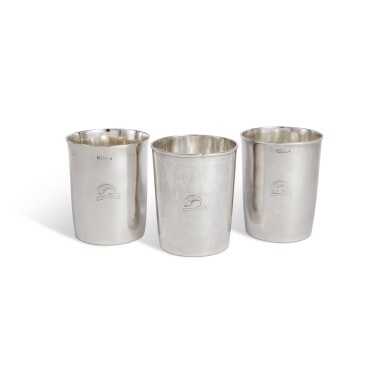
A Set of Three American Silver Beakers with the Sargent Crest, Paul Revere, Jr., Boston, Massachusetts, circa 1785-90
Auction Closed
April 20, 12:24 AM GMT
Estimate
60,000 - 90,000 USD
Lot Details
Description
A Set of Three American Silver Beakers with the Sargent Crest, Paul Revere, Jr., Boston, Massachusetts, circa 1785-90
Of tapered cylindrical form with flared rims, each engraved with a dolphin crest, the bases numbered, beakers 2 and 5, both marked pellet Revere near rim, and 4,apparently unmarked.
3 1/4 in. (8.3 cm.) high
10 oz. 15 dwt. (334 g)
Christie's New York, January 22, 1993, lot 227
Wolf Family Collection No. 1059 (acquired from the above)
The crest is that of Sargent, probably for Paul Dudley Sargent (1745-1828).
The Sargent family were important patrons of Paul Revere Jr. Colonel Epes Sargent (d. 1762) was one of the largest landowners in Gloucester, Mass. At least three of his sons bought silver from the silversmith.
Epes Sargent Jr. (b. 1721) ordered a baptismal basin and two beakers for Gloucester Church in 1762 and 1765, a copper plate for printing bookplates in 1765 (MFA Boston), and a coffee pot in 1769 (Yale). However, his death in 1779 occurred before the form of these beakers became popular. His younger brother Daniel Sargent (b. 1730) also patronized Revere, ordering spoons with his monogram and a pair of beakers about 1780. However, those beakers are of a different shape, a French-influenced tulip form with a gadrooned foot, and the Sargent dolphin crest is joined by an engraved monogram, making it unlikely he would also own these quite different beakers (see Brian Cullity, Arts of the Federal Period, 1785-1825, 1989, no. 128, p. 99).
That leaves as the likely owner for these beakers Colonel Paul Dudley Sargent (1745-1828), a privateer and a soldier during the Revolutionary War. He was the son of Colonel Epes Sargent by his second wife (m. 1745) Catherine Winthrop Brown, a descendent of Governor John Winthrop on her father’s side and of Governor Joseph Dudley on her mother’s. Born in Salem, he was brought up in Gloucester, and it was there that he married Lucy Saunders in 1772.
According to the privately printed Colonel Paul Dudley Sargent (1920) after attending a Sons of Liberty meeting in Boston in 1772, he returned to Gloucester and raised a company, then avoided the British authorities by removing to Amherst, New Hampshire where he raised and trained a second company. This group he brought south for the Siege of Boston and he was wounded during the battle of Bunker Hill, June 17, 1775. His regiment saw service on Long Island in the summer of 1776 and in the defense of New York, particularly at Turtle Bay and Harlem in September, before retiring to Westchester and White Plains. After an illness, he joined George Washington December 23, 1776, and was among those who famously crossed the Delaware two days later. He also fought in the Battle of Princeton on January 3, 1777, but on the army going into winter quarters Sargent returned to Boston. He may have been tarnished by a scandal about plundering Loyalist houses in New York; in his court-martial trial, Ensign Matthew Macumber claimed that Sargent had ordered him to empty the houses, though Macumber was cleared.
In Boston, Sargent was active as a privateer, owning or helping finance several vessels and partnering with James Swan and others. Already in 1776 his ship Yankee had captured the much larger British Zachariah Bayley, loaded with supplied for British troops; this achievement was mentioned in letters between Washington and John Hancock. The 300 ton ship was then commissioned itself as a privateer, the Boston. Sargent was also a co-owner of the Cumberland, with 20 guns and 180 crew, and a bonder for the schooner Buckram, with 8 guns and 45 crew, both in 1777. In September 1778 he was commissioned Colonel of the 1st Regiment Essex Country Massachusetts Militia.
His activities brought Col. Sargent enough wealth that on March 2, 1781, he ordered from Paul Revere a coffee pot of almost 40 ounces, proudly engraved with his arms (Museum of Replica Handbags s, Boston). The order, and the additional £1 4 s. for the arms, is entered in Revere’s daybook. Sargent's connection with Revere likely dated back to the days of the Sons of Liberty. He was also the likely patron for a group of elaborately decorated spoons engraved with the Sargent crest, of which Patricia Kane documented six tablespoons (one Metropolitan Museum) and three teaspoons (one Worcester Art Museum). The Wolf beakers, engraved with the Sargent crest but not with any initials – unlike the beakers for his brother Daniel Sargent – likely belong to this period.
However, by the late 1780s Paul Dudley Sargent suffered reverses; the 1920 account refers to “a large interest in vessels, which were lost by capture or shipwreck.” By 1788 he moved to Sullivan, Maine, just north of Bar Harbor but at the time quite in the wilderness. He had real estate interests in the area, acquiring in 1784 Rogues Island near Portland, but he may have also been fleeing creditors. Sargent did not live there in a retired fashion, though, serving as the first Chief Justice of the Court of Common Pleas, the first Judge of Probate for Hancock County, first Representative to the General Court from Sullivan, and as Postmaster, as well as being one of the original Overseers of Bowdoin College in 1794. His well-stocked library was remarked upon, and his visits to French emigrés at nearby Fontaine Level, a short-lived French settlement on the Maine coast in the early 1790s, led to Sargent’s hosting Talleyrand during the latter’s American sojourn of 1794-96.
Paul Dudley and Lucy Sargent had eleven children, several of whom stayed in the area of coastal Maine. Paul died in 1828, a few years after ill health prevented him from seeing his old comrade-in-arms Lafayette on the latter’s 1825 return to America. His wife survived until 1840.
You May Also Like


