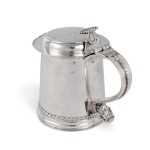

An American Silver Tankard, Charles LeRoux, New York, circa 1715
Auction Closed
April 20, 12:24 AM GMT
Estimate
20,000 - 30,000 USD
Lot Details
Description
An American Silver Tankard, Charles LeRoux, New York, circa 1715
Of tapered cylindrical form, with molded baseband topped by cut-card leaves, flat-domed cover with shaped and engraved lip, scroll handle with beaded rattail below engraved half-circle, cherub-head terminal, engraved at front S over RE and on cover S over IE, marked each side of handle C LR conjoined in oval.
6 3/8 in. (16.2 cm.) high
24 oz. (746 g)
Richard Loeb, New Jersey (mid 20th century)
Israel Sack/Ginsberg & Levy
Mr. and Mrs. Walter M. Jeffords, October 1948
Mr. and Mrs. Walter H. Jeffords, Jr., sold
Sotheby's New York, October 29, 2004, lot 735
Wolf Family Collection No. 1221 (acquired from the above)
The initials on the cover could possibly be for Johannes Schuyler (1668-1747), and his wife (m. 1695) Elisabeth Staats (d. 1737).
A pair of later salt cellars by Charles Leroux, initialed S over I A probably for John and Ann Schuyler (married 1737), is in the Metropolitan Museum (35.68.2).
This tankard is very similar to one by Charles LeRoux in the collection of the Museum of the City of New York (Waters 2000 no. 41, pp. 157-58). That piece shares the cherub head terminal, cut-card band, and shaped and engraved lip seen here.
Charles LeRoux (1689-1745) was the eldest son of silversmith Bartholomew LeRoux , brother of John LeRoux, and brother-in-law of Peter Van Dyck. He grew up in the West Ward, at the corner of Broadway and Morris Street. In 1715 he married Catarina Beekman, daughter of Dr. Gerardus and Magdalena Abeel Beekman; their son Bartholomew was baptised in 1717. Charles became a freeman in 1724/5, and served as master to Peter Quintard and Jacob Ten Eyck. In the 1723 and 1732 tax assessments, his estate is valued at £20 and £15; at the later date he owned a lot in town as well as property in Dutchess County. He was a church master for the Reformed Dutch Church in 1722 and a deacon in 1724, 1729, and 1733.
He was official silversmith to the New York City Common Council between 1720 and 1743, making freedom boxes, the Mace of the Vice-Admiralty Court, and stamps for bills of credit (see Waters 2000 fig. 5-6, pp. 36-47). In 1734 he was elected assistant alderman of the East Ward, the most densely populated and containing many of the better addresses. LeRoux was the only silversmith elected to public office between 1713 and 1750. By 1738 he was a Captain in the City Militia..
Richard Loeb (b. 1905) was an important enough buyer of American silver to appear in Charles Montgomery's list of prominent American collectors. A successful businessman even during the Depression, after a dispute with the government over his taxes he left the U.S. for Chile shortly after World War II. He gave his collection to Ginsberg & Levy to dispose of on his departure, and Jeffords was approached by both Levy and by Albert Sack about acquiring items from the group.
You May Also Like


