
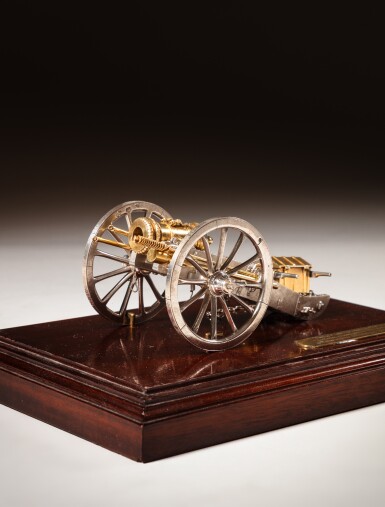
A French parcel-gilt miniature cannon, by Dominique Lorrain, Paris, circa 1825-1828
No reserve
Estimate
5,000 - 8,000 EUR
Lot Details
Description
with the elements of the cannons, on a wood base with a plaque "provenant du palais des Tuileries, exécuté pour le Comte de Chambord », marks on body and wheels: title, guarantee and maker, on the case: possibly title and maker
Long. 16 cm (6 ¼ in
Henri d'Artois, comte de Chambord (1820-1883), according to a plaque on the stand.
Henri d'Artois (1820-1883), the miracle child, was made duc de Bordeaux at birth. In 1821, thanks to a national subscription, he was given the Château de Chambord. He grew up between the royal palaces with the palais des Tuileries where his mother the duchesse de Berry moved after the murder of the duke de Berry in 1820. When the regime fell in 1830, Henri went into exile with the entire royal family, first to Scotland and then to Austria. He now bore the title of comte de Chambord, and his mother attempted to raise up part of France to reclaim the throne in his name. Henri was raised by his aunt, the duchesse d'Angoulême, daughter of Louis XVI and Marie-Antoinette. He rarely saw his mother again and knew very little about his half-siblings from the marriage with Count Hector Lucchesi-Palli. In 1844, he became heir to the throne and went to live with his aunt at Frosdorf Castle. In 1846, he married his cousin Marie-Thérèse de Modène, a marriage that remained sterile. Under the Second Empire, Henri became a major political figure without ever being able to visit France, but he renounced the throne offered to him by the Assembly following the defeat at Sedan in 1870. He did, however, make several visits to France, but died in Frohsdorf on 24 August 1883.