
Niccolò dell'Abate
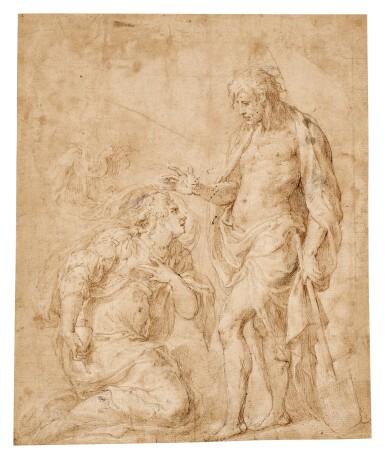
Noli me tangere (Christ and the Magdalene)
Auction is live
Lot closed
Estimate
80,000 - 120,000 USD
Lot Sold
215,900 USD
Lot Details
Description
Niccolò dell'Abate
(Modena c.1512 - 1571 Fontainebleau?)
Noli me tangere (Christ and the Magdalene)
Pen and brown ink and wash over black chalk, heightened with white;
bears inscription on the verso at upper center in pen and brown ink: del Abate(?) (canceled); and on reverse
of the mount at lower left in graphite: Boitard; further to the right in graphite: -25
242 by 200 mm; 9½ by 7⅞ in.
Cecile Hebald (1915-1998) and Milton Hebald (1917-2015), Los Angeles (their mark,
C+MH in black, not in Lugt, verso);
with Thomas Williams Replica Handbags Ltd., London by 2001
Los Angeles, University of California, The Grunwald Graphic Arts Foundation, Dickson Art Center, Studies in Drawings, Selections from the Cecile and Milton Hebald Collection, 1970, p. 16, no. 8, reproduced p. 17;
New York, The Morgan Library & Museum; Washington, D.C., National Gallery of Art, Private Treasures: Four Centuries of European Master Drawings, 2007, no. 17 (entry by Rhoda Eitel-Porter)
Poètes au jardin. De Pétrarque à Shakespeare, exhib. cat., Chateau de Pau, Musée National et Domaine du Chateau de Pau, 2023, p. 98, under cat. no. 36 (entry by Dominique Cordellier)
A rare compositional study, the Nixon drawing dates to the artist's first years in France, circa 1552-1555.1 Delicately and skilfully drawn in pen and ink, animated by multiple small parallel strokes and by a subtle use of white heightening, it is typical of Niccolò dell'Abate's elegant graphic style. The drawing must relate to a lost work or a project that was never executed, but the fame of this composition is confirmed by the existence of two copies by different hands, both similar in scale to the Nixon drawing.
When the present drawing was exhibited in 1970, at which time it was in the collection of Cecile and Milton Hebald (see Exhibited), Merle Schipper already noted the link with one of those copies, in the Louvre,2 which was also mentioned by Eitel-Porter in her own 2007 catalogue entry for the drawing, and, more recently, in another entry by Dominique Cordellier (see Literature). Though as Cordellier notes, the Louvre drawing, originally in the inventory of Everhard Jabach as Primaticcio, 'preserves only the compositional scheme and the subject..' of the Nixon drawing, and actually seems to be copied not directly from the present drawing, but from another version of the same composition that was unknown before its emergence on the American art market in 2021.3 The appearance of this previously unknown second copy, unarguably the work of an artist active in the School of Fontainebleau, shows how significant was the impact of the original study by Niccolò dell'Abate in the Nixon Collection, which might have been made as the design for an altarpiece, but could also have been intended for a small-scale devotional painting, of a type much favoured in the refined artistic milieu of Fontainebleau.
As Cordellier has also pointed out, the specific iconography of the Noli me Tangere that we see in this drawing is the same as in one of two polychrome enamel medallions, made in 1552–53 by Léonard Limosin (1505-1577), after designs by Niccolò dell’Abate, for the Resurrection altarpiece of the Sainte-Chapelle, Paris.4 For this work, Niccolò dell’Abate—who had only recently arrived in France—still follows the iconography for the Noli me Tangere chosen by Correggio in Parma in 1525, in his painting now in the Prado, where Mary Magdalene appears kneeling in profile, her face turned toward a half-draped Christ, who stands before her and holds as his main attribute a gardening tool.
As told in the Gospels (John 20: 14-18), after the Resurrection Christ appears to the Magdalene, who has come to anoint his body, and comforts her. At first she mistakes him for a gardener; when she recognizes him, he tells her not to touch him, a subject referred to by Saint Jerome, in the Vulgate, as Noli me tangere (‘Do not touch me’), the phrase now used to designate the scene.
Besides the debt to Correggio's iconography mentioned by Cordellier, and the well-known familiarity of the artist with the oeuvre of Parmigianino, Niccolò dell’Abate was also clearly at the same time aware of the work of Tuscan mannerists, such as Francesco Salviati (1510-1563) and Giorgio Vasari (1511-1574), whose influence cannot be ignored when admiring this monumental composition. See for instance Vasari's drawing, Christ taking leave from his mother, where the figure of Christ seen in profile, inspired by a Dürer woodcut of the subject from the Life of the Virgin (circa 1503-1505), has a very similar majestic pose.5
Niccolò dell’Abate earliest surviving works are the Aeneid frescoes for the Rocca dei Boiardo, Scandiano, which date from around 1540.6 After a sojourn in Bologna, where he had moved by 1550, he was invited to France by Henri II, in 1552, to become the principal assistant of Francesco Primaticcio (1504-1570) in the extraordinary decoration of the celebrated Galerie d'Ulysse and the Salle de Bal at Fontainebleau. He was to remain in France until his death, and together with Rosso Fiorentino (1494-1540) and Primaticcio, he became one of the preeminent artists of the first school of Fontainebleau, whose style was - as the Nixon drawing clearly demonstrates - highly influential in France.
1.Sylvie Béguin, in a letter to M. Schipper, dated 3 March 1969, had previously associated the present sheet to the decoration of the Hôtel du Faur (also known as the Hôtel Torpanne) built in 1567, and now destroyed
2.Paris, Louvre, Département des Arts graphiques, inv. 5838
3.Thomaston, ME, Thomaston Place Auction Galleries, 28 August 2021, lot 2252 (as Jacopino del Conte)
4. Paris, Musée du Louvre, Department of Decorative Arts
5.Vienna, Albertina, inv. no. 505; see F. Härb, The Drawings of Giorgio Vasari (1511-1574), Rome 2015, pp. 514-515, reproduced
6.The detached frescoes are now preserved in the Galleria Estense, Modena; see Nicolò dell'Abate, exh. cat., Foro Boario, Modena, 2005, pp. 263-271, reproduced


