
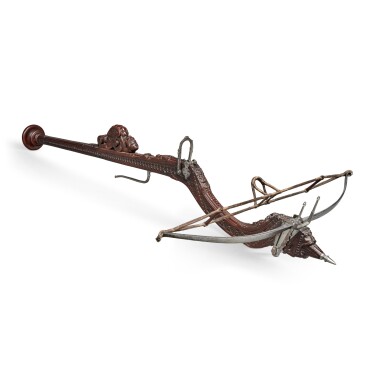
A Florentine Mannerist Crossbow, Circa 1600
Auction Closed
February 9, 09:35 PM GMT
Estimate
20,000 - 30,000 USD
Lot Details
Description
The crossbow decorated in the manner of Dionigi Nigetti, the spring steel prod mounted in a walnut stock carved with grotesque masks and acanthus, guilloche and piastre mouldings, the metal tip issuing from a carved lion’s mask; on a modern stand
length 36 in.; width 19 ½ in.
91.5 cm; 49.5 cm
Pelham Galleries, London;
From whom acquired by Aso O. Tavitian at TEFAF Maastricht, 2007.
A very similar Florentine crossbow dated c.1570-80 is in the collection of the Museo Bardini, Florence (illustrated in Armi e Armati, exhibition catalogue, Museo Bardini, Florence 1989, cat. no. 20. p.45), and a comparable but more richly decorated crossbow, of the type reputedly used by the Medici, is illustrated in L. G. Boccia, Nove secoli di armi da caccia (Florence 1967), p.69. Several further related examples are in the collection of the Museo Poldi-Pezzoli, Milan (illustrated in Domencio Collura, Armi e armature, Milan 1980, nos. 865-868, p.150-51), including a 17th century crossbow with a turned finial almost identical to that on the present piece.
The ornamental carving is inspired by the designs of the Florentine mannerist artist Giorgio Vasari and is very similar to the work of the wood sculptor Dionigi Nigetti, who worked with Vasari and among other projects executed the ceiling and cabinets for the Sala delle Carte Geografiche in the Palazzo Vecchio in Florence.
The use of crossbows as weapons is recorded as early as the fourth century B.C. in China and Greece, and by the 10th century A.D. was in common use in European warfare. By the end of the 14th century it was such an important arm on the Continent that crossbowmen in Spain were granted the rank of knight, and in France the title of Master Crossbowman (Grand maître des arbalétriers) became one of the highest non-noble honors bestowable. By the late 1400s, their use began to be supplanted by that of handguns, although in 1494 Paolo Giovo wrote that ‘at the entry of Charles VIII into Rome in 1494, there were 500 Gascons among the troops, carrying crossbows with steel bows’ (cited in Sir Ralph Payne-Gallwey Bt, The Crossbow: Its Construction, History and Management, London 1958, p.48). By the late 16th century, however, crossbows had become obsolete in warfare and were primarily used for hunting, especially in Italy.
You May Also Like


