
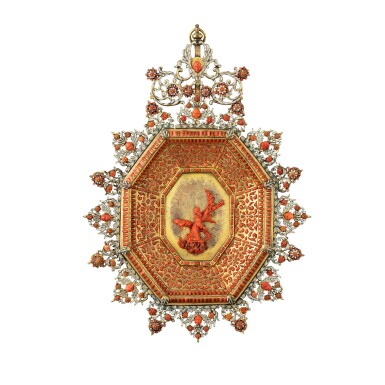
A Sicilian, Trapani coral inlaid and gilt copper octagonal devotional plaque with Saint Francis, Late 17th century
Auction Closed
October 12, 05:41 PM GMT
Estimate
40,000 - 60,000 EUR
Lot Details
Description
A Sicilian, Trapani coral inlaid and gilt copper octagonal devotional plaque with Saint Francis,
Late 17th century
coral inlaid gilt copper, mounted in an enamel and gilt copper framing; the reverse engraved with Saint Francis surrounded by foliate scrolls
height 19⅓ in.; length 14⅐ in.; 49 cm; 36 cm
____________________________________________
Bénitier octogonal avec la Vision de Saint François en corail et cuivre doré partiellement émaillé,
Sicile, Trapani, fin XVIIe siècle
corail et cuivre doré partiellement émaillé ; le revers gravé avec Saint François au centre, entouré de volutes feuillagés
hauteur 19⅓ in.; largeur 14⅐ in.; 49 cm; 36 cm
Collection Luigi Koelliker
Sotheby's London, the Luigi Koelliker Studiolo, 3 December 2008, lot 50
____________________________________________
Collection Koelliker
Sotheby's Londres, the Luigi Koelliker Studiolo, 3 décembre 2008, lot 50
Related Literature
M. Concetta Di Natale, Il Corallo Trapanese nei secoli XVI e XVII, Brescia, 2002, no. 17, pp. 56-57
Museo Regionale Pepoli, Coralli, Talismani Sacri e Profani, Trapani, 1986, nos. 76 and 82
Museo di Capodimonte e Museo Pignatelli, Civiltà del seicento a Napoli, Naples, 1985
G. C. Ascione, Gloria del Corallo a Napoli dal XVI al XIX Secolo, Naples, 1991
A. Dameu, L'Arte Trapanese del Corallo, Milan, 1964
The ancient fishing port of Trapani on the west coast of Sicily was renowned from the 16th to the 18th centuries for its production of objects made from local red coral. The guild of the coral workers, the Arte dei Corallari was established in Trapani in 1628 and after the suppression of the insurrection in 1672, the skilled coral workers were dispersed to other Mediterranean centres.
Coral was esteemed both for its colour and unusual texture, and it was believed (as was already the case in antiquity) to have the power to ward off the 'evil eye'. Since the 16th century, small coral trees were appreciated as rare ‘natural objects’, mounted on silver bases.
Most common were capezzale, devotional plaques with religious figures set in engraved copper frames with rich coral inlay and enamel decoration. Other works included liturgical items such as chalices and crucifixes, as well as secular objects like jewelry, inkstands, and small caskets, many of which made their way into the European Kunstkammern and Cabinets de Curiosité.
You May Also Like


