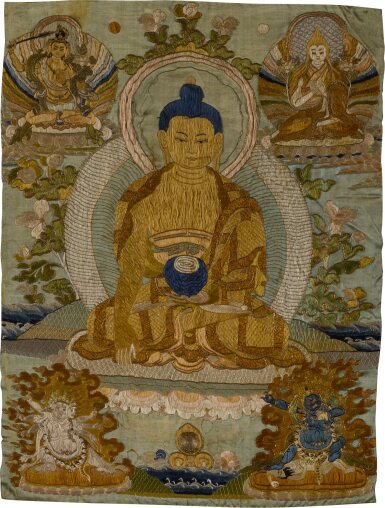
An embroidered silk thangka depicting Shakyamuni Buddha, Qing dynasty, Kangxi period | 清康熙 刺繡釋迦牟尼佛唐卡
Auction Closed
September 20, 03:13 PM GTNN
Estimate
30,000 - 40,000 USD
Lot Details
Description
An embroidered silk thangka depicting Shakyamuni Buddha
Qing dynasty, Kangxi period
清康熙 刺繡釋迦牟尼佛唐卡
framed
Himalayan Art Resources item no. 13817
鏡框
HAR編號13817
Height 17⅞ in., 45.5 cm; Width 13⅜ in., 34.3 cm
Exquisitely embroidered in satin stitch on a light green ground, the present thangka depicts Shakyamuni Buddha, seated in dhyanasana on a lotus throne, emitting rays of light in the form of fine gold couched threads, surrounded by wreaths of flowers. Above him are Manjushri and Tsongkhapa, with Hayagriva and Mahakala below, also supported on lotus thrones.
This thangka was likely based on a painted Tibetan thangka, and reflects the development of the uniquely Tibeto-Chinese style that arose out of the Qing emperors' patronage of Tibetan Buddhism. Following the Chinese tradition of creating embroidered and kesi versions of scroll paintings, painted Tibetan Buddhist images were similarly replicated in luxurious textiles from the Yuan dynasty onwards, and reached new heights during the Qing period. The extraordinary value and the beauty of these lustrous, vibrant textiles made these 'copies' much more valuable than the painted 'originals'.
In comparison to later Qianlong period examples, Kangxi silk embroidered thangka are rare. An early 18th century thangka, depicting Shakyamuni with Tsongkhapa and members of the Geluk school above, is in the collects ion of the Metropolitan Museum of Art, New York (accession no. 51.129). Another example depicting Ekadashamukha Avalokiteshvara is stylistically related to the present price and was sold in these rooms, 10th September 2019, lot 327. Compare a thangka depicting Manjushri, attributed to the 17th-18th century, also in the collects ion of the Metropolitan Museum of Art, New York (accession no. 15.95.154). Finally, see a similarly composed portrait of Green Tara, illustrated in Series of the Gem of Beijing Cultural Relics: Textiles and Embroidery, Beijing, 2001, pl. 199.
You May Also Like


