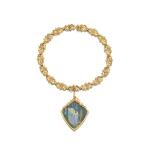

Iconic Jewels: Her Sense of Style
Falize
Gold and enamel pendent necklace, circa 1900
Auction Closed
May 14, 05:29 PM GMT
Estimate
40,000 - 80,000 CHF
Lot Details
Description
The necklace of mistletoe design suspending a detachable lozenge-shaped pendant depicting an enamelled druid scene, length approximately 390mm, unsigned, French import mark for gold, case stamped Falize.
Falize - A Dynasty of Jewellers, a Loan Exhibition, Wartski, London, 10 to 19 June 1999, where this jewel was exhibited, item 135, pg. 30 in the catalogue.
Cf: Katherine Purcell, Falize - A Dynasty of Jewellers, London, 1999, pg. 262-263 where this jewel is illustrated with a likely attribution to Falize Frères instead of Lucien Falize.
Falize: Three Generations of Excellence
The renowned French jewellery house of Falize was founded in the mid-19th century and existed for three generations, soaring to the greatest heights of artistic achievement. Falize was at the forefront of stylistic innovation; initially working in the historical style and later exploring Japonisme, they eventually championed the budding Art Nouveau movement.
Alexis Falize (1811-1898) started his career under the jeweller Mellerio dits Meller in 1832. In 1838, he established his own workshop with a strong emphasis on refined and intricate enameling techniques. During the Second French Empire (1852-1870), his work frequently took inspiration from a variety of different historical periods, in particular the French Renaissance, as well as distant cultures. Through his great endeavours, he elevated jewellery as a form of decorative art. In 1876, Alexis Falize retired and was succeeded by his son Lucien (1839-1897).
In the 19th century, World Fairs were a highly public opportunity for the rapidly modernising countries of the Western World to trumpet their best innovations in industry and art. The London Great Exhibition of 1851, the 1873 Vienna World Fair and the Parisian Expositions Universelles of 1855, 1867, 1878, 1889 and 1900, all formed a prestigious world stage where the best artists and craftsmen of each nation could distinguish themselves. In 1878, Lucien Falize won a grand prize at the World’s Fair and was awarded the Légion d’Honneur for his outstanding achievements in the jeweller’s art.
That same year, Falize entered into association with Bapst, the former French Crown Jeweller, benefitting from Bapst’s longstanding relationship with the French high aristocracy. This successful partnership lasted until 1892. Lucien Falize had a great interest in Japanese art and channeled the firm’s expertise in enameling to create highly sophisticated pieces emulating Japanese examples. He was also a key figure in the Art Nouveau movement, writing extensively on the development of French jewellery design during the 1880s and 1890s. Lucien Falize’s clients included some of the most influential characters of fin de siècle Paris including the actress Sarah Bernhardt and the writer Colette.
When Lucien suddenly passed away in 1897, his three sons André, Jean and Pierre continued the family business under the name of Falize Frères. Like their father before them, they were awarded grand prizes at the 1900 Paris Exposition Universelle. For decades, they successfully enriched their family legacy, first working in the art nouveau style and later adopting an art deco aesthetic. Falize Frères ultimately ceased activity in 1936.
You May Also Like


