
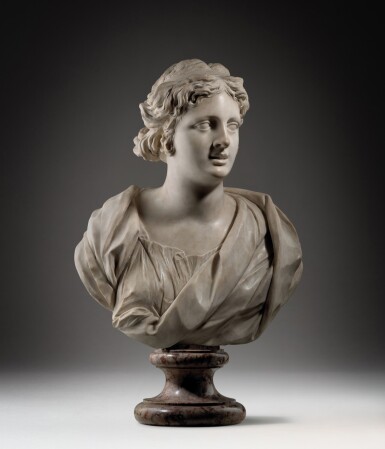
Melchior Barthel (1625 - 1672)
Bust of a Woman | Buste de Femme
Auction Closed
November 15, 06:03 PM GMT
Estimate
30,000 - 50,000 EUR
Lot Details
Description
Melchior Barthel
1625 - 1672
Italian, Venice, circa 1655-1660
Bust of a Woman
Carrara marble bust
H. 72cm; 28¼in. (excluding base)
____________________________________________
Melchior Barthel
1625 - 1672
Italie, Venise, vers 1655-1660
Buste de Femme
buste en marbre de Carrare
H. 72 cm ; 28 ¼ in. (sans le piédouche)
Private collection, Belgium
____________________________________________
Collection privée, Belgique
S. Guerriero, La Venere di Melchior Barthel per l’arciduca Leopoldo Guglielmo d’Asburgo, Verona, 2002, p. 36-37 (illustrated), cat. 36
This imposing bust of a woman is inspired by portraits of classical antiquity but conceived with an overtly Baroque expression and noticeable ingenuity. Her eyes are wide open, her gaze is focussed, her lips are slightly parted in an animated manner, and her hair is loosely gathered in a bun and decorated with a modest headband. The drapery is skilfully carved and comprises fine rippled folds along her chest, layered with heavy drapery across her torso and over both shoulders.
The stylistic traits and autonomous features convincingly attribute the bust to the Saxon artist, Melchior Barthel. Originating from Dresden, Barthel was active in Venice from 1653 until he moved back to Dresden in 1670 where he was appointed sculptor to the court. Barthel was a prominent 17th century sculptor and also a renowned ivory carver and innovated the Venetian sculptural landscape with numerous prestigious commissions, including the Monument to Lorenzo Dolfin in San Lorenzo dei Mendicanti and the funerary monument to Doge Giovanni Pesaro in the Basilica dei Frari, which was in collaboration with his friend and architect Baldassare Longhena (1598-1682). The latter includes two allegorical groups of Religion and Constancy, and of Truth and Justice which reflect the Doge’s virtues. The figure of Truth compares closely to the present bust and demonstrates a similar treatment of the loosely arranged hair and physiognomy of the face with straight nose and parted lips. Barthel’s monument to Lorenzo Dolfin is also adorned with two allegorical figures, including a personification of Justice, which demonstrates convincing parallels to the present bust: the facial features and drapery with heavy folds carved with undercuts and sharp recesses, as well as the hairstyle which is parted with a headband and arranged in a bun in a nonchalant fashion, with short loose strands on either side of the face. A more technical comparable feature and also indicative of Barthel’s hand, is that the hair reveals tool marks, creating a slightly rough although virtuoso finish, which contrasts beautifully with the polished surface of the skin.
Another close comparison is Barthel’s Bust of the Dying Alexander the Great, commissioned by the 114th Doge of Venice, Alvise Pisani (1664-1741) for his residence in Piazza San Marco, and is now in the Villa Pisani Museo Nazionale, Stra. The animated expression and softened facial features, with parted lips, classicising eyes hooded by naturalistic brows, in both busts would suggest that they are carved by the same hand.
In addition, the bust is published by the scholar Simone Guerriero, who discussed the marble alongside two further busts of women, one in the Museo di Santa Giulia in Brescia and another in the Museo Civici in Treviso. The author notes the clear stylistic links to Barthel’s documented works and compares the three busts to the allegory of Justice mentioned above.
The clear parallels drawn above firmly attribute the present bust to Melchior Barthel’s oeuvre. The grandiose baroque style of the bust is expertly balanced with classicising elements and softened features, which is characteristic of the naturalised Venetian sculptor, Melchior Barthel.
RELATED LITERATURE / RÉFÉRENCES BIBLIOGRAPHIQUES
J. von Sandrart, L’Academia Todesca della Architectura Scultura et Pictura: Oder Teutsche Academie der Edlen Bau-Bild und Mahlerey-Künste, 1. Teil, Nuremberg, 1675;
L. Procacci, U. Procacci, Il carteggio di Marco Boschini con il Cardinale Leopoldo de’ Medici, Venice, 1965, pp. 87-114, 96-97;
C. Semenzato, La scultura veneta del Seicento e del Settecento, Venice, 1966, pp. 23-25, 88;
E. Borea, C. Gasparri (ed.), L’Idea del Bello. Viaggio per Roma nel Seicento con Giovan Pietro Bellori, exh. cat. Palazzo delle Esposizioni ed ex Teatro dei Dioscuri, Rome, 2000, pp. 401-402, cat. 5-6;
M. Clemente, And with the Chisel you Give Life to Marbles: Melchior Barthel and the Satyr for Archduke Leopold Wilhelm of Austria, GALLERIA CARLO VIRGILIO & C., Rome, 2023
You May Also Like


