
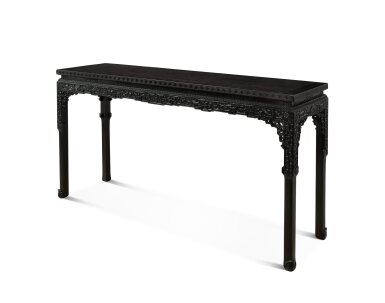
A rare and finely carved imperial zitan corner-leg table, tiaozhuo, Qing dynasty, 18th–early 19th century | 清 十八世紀至十九世紀早期 紫檀雕仿古紋束腰條桌
Auction Closed
May 7, 10:26 AM GMT
Estimate
2,000,000 - 4,000,000 HKD
Lot Details
Description
171.4 cm by 43.8 cm h. 85.2 cm
Frank Caro, New York, 1967.
Arthur M. Sackler (1913–1987) Collections.
Sackler Collections at Columbia University, New York.
Arthur M. Sackler Foundation, 2001.
An important New York private collection.
Christie's New York, 20th/21st March 2014, lot 2306.
A distinguished Asian private collection.
Bonhams Hong Kong, 28th May 2019, lot 123.
The Bride Wore Red: Chinese Wedding Traditions, The Newark Museum, Newark, 2005.
來源
紐約古董商弗蘭克·卡羅,1967年
阿瑟·M·賽克勒舊藏
紐約哥倫比亞大學賽克勒舊藏
阿瑟·M·賽克勒基金會舊藏,2001年
紐約重要私人舊藏
佳士得紐約2014年3月20-21日,拍品編號2306
亞洲顯赫私人收藏
香港邦瀚斯2019年5月28日,拍品編號123
展覽
《The Bride Wore Red: Chinese Wedding Traditions》,紐華克博物館,紐華克,2005年
The present archaistic zitan table exemplifies the opulent Imperial taste and refined aesthetic sensibilities of the Qianlong and Jiaqing reigns. The archaistic motifs adorning the apron, forming taotie masks, are directly derived from those seen on bronze ritual vessels of the Shang and Zhou dynasties. This reflects the Qianlong Emperor’s deep admiration for antiquity and archaism. Advocating for the revival of ancient styles, he viewed early cultural expressions as embodying sincerity, simplicity, and joyous exuberance. To facilitate this, he instructed the Court to compile records of antiquities, such as the Xi Qing Gu Jian (Catalogue of Xiqing Antiquities), which served as a vital reference for Imperial artisans. See Chang Li-tuan, The Refined Taste of the Emperor: Special Exhibition of Archaic and Pictorial Jades of the Ch’ing Court, Taipei, 1997, pp. 49–50.
Zitan wood, known for its extreme hardness, is particularly well-suited for intricate carving. While Ming dynasty furniture was characterised by a more restrained aesthetic, favouring simplicity and unembellished surfaces, Qing dynasty imperial taste embraced a more elaborate and extravagant style. However, due to the slow growth of zitan, its availability was already limited during the Qianlong period, prompting strict regulation of its usage within the Imperial Household Department. Archival records from the department reveal the meticulous oversight applied to the allocation of this prized material.
Tables of this type, including the present example, were typically arranged in pairs within grand palace halls and primarily used for the display of treasured objects. A historical photograph taken in 1900 within the Hall of Mental Cultivation in the Forbidden City depicts a comparable table, as seen in Shan Jixiang, The Photographic Collection of the Palace Museum: Imperial Buildings through Western Camera, Beijing, 2014, p. 160. Additionally, four other zitan tables featuring similar archaistic designs from the Qing dynasty are illustrated in A Treasury of Ming and Qing Dynasty Palace Furniture from the Palace Museum Collection, vol. 1, Beijing, 2007, pls 203, 221, 223, and 225.
紫檀為材,格角攢框裝板構成案面,冰盤沿四周環繞雕刻回紋,束腰部分則飾以浮雕如意蝙蝠紋,間距均勻,寓意吉祥。托腮處淺浮雕蓮瓣紋,形態猶如須彌座。牙板與桌腿採用抱肩榫結合,牢固嚴謹,牙板下緣雕刻拐子回紋,與桌腿相連,整體線條流暢。板面鏟地雕飾仿古雲榖紋,與牙板的紋飾相呼應,桌腿與牙板之間安置鏤空螭龍角牙,腿部線條挺拔,上部鏟地雕仿古雲榖紋,與牙板紋飾渾然一體,方腿光素簡約,足端外翻呈雲紋形態,顯得端莊穩重。
此案選材精良,用料極為考究,氣勢恢宏,充分展現皇家氣度。紫檀質地堅硬,適宜精雕細琢。清代家具風格不同於明式家具的素雅簡約,而是更趨向繁複華美的審美取向。然而,由於紫檀生長極為緩慢,至乾隆朝時,內務府的紫檀存量已十分有限,因此管理愈加嚴格。《養心殿造辦處各作成活計清檔》記載,紫檀僅供內務府造辦處使用,並受到嚴格監管,可見其珍貴程度。
此類條案主要用於陳設器物,通常成對擺放於廳堂兩側。紫禁城養心殿隨安室1900年的一張室內照片中,可見光緒帝御榻一側擺放有一張與本件拍品極為相似的紫檀條案,見單霽翔編,《故宮藏影·西洋鏡裡的皇家建築》,北京,2014年,頁160。此外,另有四件清代紫檀桌可作參考,其牙條所雕刻的仿古紋飾亦可對比,見《故宮博物院藏明清宮廷家具大觀》,卷1,北京,2007年,圖版203、221、223及225。