
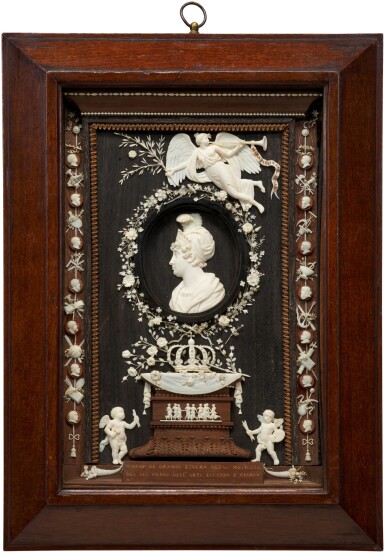
An Italian bone and wood microsculpture relief of Maria Theresa of Austria-Este (1773-1832), Giuseppe Maria Bonzanigo (1745-1820) and workshop, circa 1815-1820, Turin
Estimate
4,000 - 6,000 EUR
Lot Details
Description
inscribed MARIA TERESA REG. DI SARD. and A ONOR DE' GRANDI ETERNA ALZAR MEMORIA / DEL BEL GENIO DELL'ARTI ECCELSA È GLORIA
outer frame: 30.5 cm high, 22.2 cm wide; in. 12 by 8 ¾
Related Literature
C. Bertolotto, et. al., Giuseppe Maria Bonzanigo: intaglio minuto e grande decorazione, exhibition catalogue, Pinacoteca civica, Asti, 1989
G. Ferraris, Giuseppe Bonzanigo e la scultura decorativa in legno a Torino nel periodo neoclassico (1770-1830), Turin, 1991
Please note that this lot includes endangered species, which will require a CITES permit for export. Please refer to the Guide for Buyers at Auction and Conditions of Business for Buyers for additional information.
Sotheby's New York, 27 January 2011, lot. 492.
This finely carved bone and wood relief celebrates the artistic patronage of Maria Theresa of Austria-Este, Queen of Sardinia, and stands as a rare testament to the exceptional craftsmanship that secured Giuseppe Maria Bonzanigo the favor of the Savoy court. Likely executed under magnification, the minute detailing — visible in the floral wreath, the trophies symbolising the arts, the crown entwined with a rose branch, and the cameo portrait of the Queen — demonstrates a remarkable precision seldom encountered in sculpture of any period. For a comparable portrait of the sitter, see Bertolotto, op. cit., p. 48, fig. 16.
Born Archduchess of Austria and Princess of Modena, Maria Theresa married Victor Emmanuel, Duke of Aosta (later King Victor Emmanuel I), in 1789. She became Queen consort in 1802 following the abdication of Charles Emmanuel IV and remained in Sardinia during the Napoleonic years, returning to Turin in 1814. Political tensions led to her husband’s abdication in 1821 in favour of his brother, Charles Felix.
Giuseppe Maria Bonzanigo (Asti, 1745 – Turin, 1820) settled in Turin in 1773 and soon entered the service of the Savoy court. Appointed official wood-carver to Victor Amadeus III in 1787, he worked extensively for the royal residences at Turin, Moncalieri, Rivoli, Stupinigi and Venaria. Renowned for his virtuoso carvings in light wood and bone — the so-called microsculpture — he was reinstated as royal sculptor in 1815 after the fall of Napoleon. At his death, the Gazzetta Piemontese praised him for having brought the art of carving “to the highest degree of perfection” through forty years of devoted practice.
You May Also Like


