
Property from the Junkunc Collection
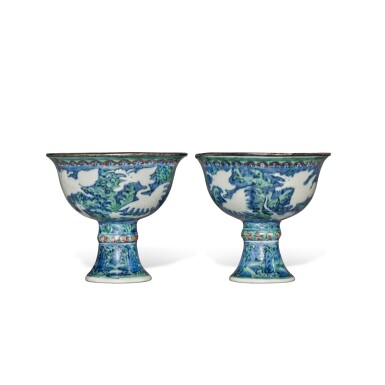
An extremely rare pair of blue and white 'mythical beasts' stem cups, Marks and period of Wanli
Live auction begins on:
March 25, 01:30 PM GMT
Estimate
40,000 - 60,000 USD
Lot Details
Description
with later-added iron-red and green enamels, the interior of each with nine underglaze-blue lança characters, and the base inscribed with a six-character mark in underglaze blue within a double circle (2)
Diameter 3⅜ in., 8.5 cm
Nagatani, Chicago, 12th January 1959.
Collection of Stephen Junkunc, III (d. 1978).
Stemcups made in the Wanli period and decorated with sea creatures are rare, and those with details painted in overglaze green and iron red are even rarer. The design was modeled after Xuande period (r. 1426-1435) prototypes, which by the Wanli reign had become highly valuable and much sought after. A reconstructed Xuande mark and period stemcup painted in underglaze blue with this design, unearthed from the waste heaps of the Imperial kiln factory at Jingdezhen, is illustrated in Imperial Porcelain from the Reign of Xuande in the Ming Dynasty, Beijing, 2018, pl. 29. Known as haishou (sea creatures), the nine animals on these stemcups are believed to depict mythological creatures from the famous Shanhaijing (Classics of Mountains and Seas). Written between the Warring States period (475-221 B.C.) and the Han dynasty (206 B.C.-A.D. 220), it is a compilation of mythological stories and geographical information. The Sanskrit characters on the interior of these stemcups suggest an association with Tibetan Buddhism. It is likely that stemcups of this type were made as tribute gifts to Tibetan lamas. A Xuande mark and period stemcup with Sanskrit characters on the interior, and the exterior painted in wucai enamels with ducks swimming in a lotus pond, in the Sa-skya Monastery, Tibet, was included in the exhibition Treasures from Snow Mountains. Gems of Tibetan Cultural Relics, Shanghai Museum, Shanghai, 2001, cat. no. 94.
While no other closely related stemcup appears to be known, a stemcup painted with this design but lacking the overglaze enamels was sold at Christie's Hong Kong, 29th May 2013, lot 2247. Wanli mark and period stemcups with the creatures painted in underglaze blue against a white ground, but lacking the Sanskrit characters, are more commonly known. See for example, a pair from the collection of the Idemitsu Museum of Arts, Tokyo, later in the Meiyintang Collection, illustrated in Regina Krahl, Chinese Ceramics from the Meiyintang Collection, vol. 4, London, 2010, pl. 1696, and sold twice in our London rooms in 1970 and 1986, and in our Hong Kong rooms in 1988 and again, 7th April 2011, lot 71; and a stemcup sold at Christie's New York, 20th September 2005, lot 262.
The motif is also known on stemcups with an apocryphal Xuande mark, such as one from the Sir Percival David Collection, now in the British Museum, London, illustrated in Margaret Medley, Illustrated Catalogue of Underglaze Blue and Copper Red Decorated Porcelains, London, 1976, pl. C601.
You May Also Like


