
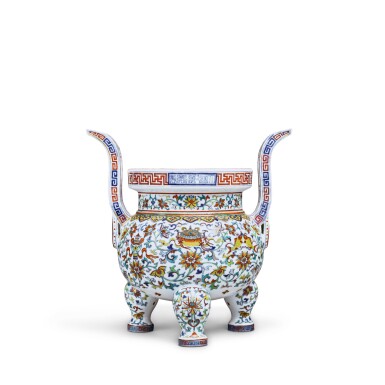
A rare and impressive doucai 'Eight Buddhist Emblems' tripod censer, Seal mark and period of Qianlong
Live auction begins on:
March 25, 01:30 PM GMT
Estimate
40,000 - 60,000 USD
Lot Details
Description
the rim with a six-character seal mark in underglaze blue, wood cover (2)
Height 11⅛ in., 28.4 cm
Collection of Nathaniel Shear III (label).
Benjamin Ferber, New York.
American Private Collection, acquired from the above in the early 20th century.
New York Private Collection.
The present censer belongs to a distinguished lineage of imperial porcelain incense burners produced for ritual and contemplative use at the Qing court. Its tripod form consciously recalls archaic bronze ding censers of antiquity, vessels long associated with ritual propriety, moral authority, and the legitimizing power of the past. Such references were central to Qing imperial visual culture, in which the revival and reinterpretation of ancient forms served as a means of aligning contemporary rule with classical precedent.
Delicately painted in doucai, with the censer is decorated with the Eight Buddhist Emblems (bajixiang), a Buddhist iconographic programme introduced to China from India and assimilated into the imperial decorative vocabulary during the Yuan dynasty. By the eighteenth century, these symbols, conveying ideals of harmony, spiritual attainment, and cosmic order, had become firmly embedded in court production, particularly on vessels intended for ritual or devotional contexts.
Censers of this type occupied a central place within the ritual and aesthetic life of the Qing court. Intended not merely as utilitarian objects but as vehicles for cultivated taste and ideological expression, they exemplify the court’s synthesis of antiquarian scholarship, technical virtuosity, and symbolic precision, embodying the measured elegance and intellectual ambition that define imperial porcelain of during the Qianlong Emperor's reign.
For closely related censers of the same form and decorated with the Eight Buddhist Emblems, see one included in The Centenary Exhibition: Imperial Porcelain of Kangxi, Yongzheng and Qianlong, Marchant, London, 2025, cat. no. 23; and another, decorated with a band of pendent leaves to the neck, in the National Palace Museum, Taipei (accession no. 中瓷003881), illustrated on the Museum's website. The present censer would have originally been a part of a five-piece garniture set, all decorated in a similar manner. For a closely related five-piece Qianlong mark and period garniture set, see one most recently sold in our London rooms, 11th May 2011, lot 230 (Fig. 1). Another set, but decorated with lotus scrolls, previously in the Meiyintang Collection, was sold in our Hong Kong rooms, 3rd April 2012, lot 50.
You May Also Like


