
Property from an Important New York Private Collection
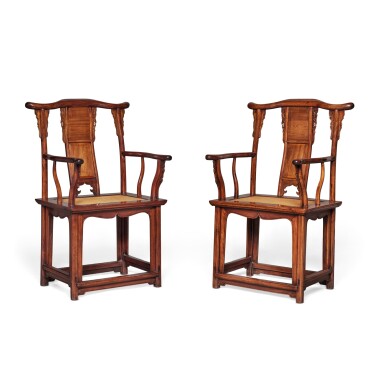
A rare pair of 'huanghuali' 'official's hat' armchairs (Sichutou guanmaoyi), 17th century
Live auction begins on:
March 25, 01:30 PM GMT
Estimate
80,000 - 120,000 USD
Lot Details
Description
(2)
Height 46 in., 116.8 cm; Width 26¼ in., 66.7 cm; Depth 24¾ in., 62.9 cm
Collection of Mrs. Mary Kennedy (1896-1987).
Robert Ellsworth, New York, 1980s (by repute).
Metropolitan Museum of Art, New York, by 1956 (L.56.15.1, .2) (on loan).
Robert Ellsworth, Chinese Furniture, Hardwood Examples of the Ming and Early Qing Dynasties, New York, 1970, p. 119, no. 11.
Michel Beurdeley, Chinese Furniture, New York, 1979, p. 77, no. 96.
These rare and celebrated huanghuali yokeback armchairs highlight the bespoke and sometimes eccentric nature of late-Ming hardwood furniture. Although extant examples have helped twentieth-century scholars such as Wang Shixiang establish the canon of Ming-dynasty forms, it must not be forgotten that almost all works of furniture (with the exception of those few pieces carried out in the imperial workshops) were the products of individual workshops across various regions, and were often carried out per the individual requests of wealthy patrons.
This adaptable style is evident in the present pair of chairs, particularly in the carved spandrels that are found below the crestrail on either side of the back splat and backposts. While examples of yokeback or ‘four-corners-exposed’ (sichutou) armchairs with carved spandrels on either side of the back spat are known – see, for example, a pair of huanghuali and huamu ‘Fu’ character yokeback armchairs originally in the collection of the Reverand Richard Fabian and sold in these rooms, 15th March 2016, lot 31 – examples of the present form with spandrels on either side of the back posts are exceedingly rare. The presence of long narrow patches along the front and back posts and struts below the armrests indicate there was once an even greater number of decorative spandrels incorporated into the design, and may have been removed due to changes in taste.
Perhaps the closest comparison can be made to certain types of ‘Southern official’s hat’ armchairs (nanguanmaoyi) that have shaped spandrels at the intersection of the crestrail and backposts such as a magnificent pair of large huanghuali continuous yokeback armchairs sold in our London rooms, 4th November 2020, lot 107.
Another uncommon feature of the present pair is the presence of molded panels of huanghuali within the frame of the back splat, with panels of huamu burl, Dali marble or even nanmu more commonly found. The panels have been arranged such that the grain of the panel above is perpendicular to that of the panel below. Furthermore, the top panels conspicuously include large, circular figuration, an obviously intentional choice on the part of the craftsman, perhaps invoking pools of water or clouds. While unusual, the selection of huanghuali panels might have been a conscious display of wealth, with the precious hardwood being more expensive than the alternatives. In any case, the bright golden hues of the panels are juxtaposed by the darker patina of the frame timber, creating an interplay between the two tones that delights the eye. In Michel Beurdeley’s discussion of these chairs in Chinese Furniture, New York and Toyko, 1979, no. 96, he suggests the frame and posts may have at one point been covered in dark lacquer, which would have further enhanced the contrasting colors.