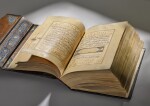

An illuminated Qur'an, Persia, Timurid or Aqqoyunlu, second half 15th century
Auction Closed
April 26, 01:36 PM GTNN
Estimate
80,000 - 120,000 GBP
Lot Details
Description
Arabic manuscript on paper, 418 leaves, plus 2 fly-leaves, 12 lines to the page, the first and twelfth lines in thuluth in gold, the remaining lines in neat naskh in black ink, ruled in gold, black and blue, verses separated by gold and blue rosettes, further text divisions marked by gold and polychrome illuminated marginal medallions and red thuluth, surah headings in gold thuluth on a ground of gold scrolls within illuminated panels, surah headings for surah ya-sin and surah Nuh in gold muhaqqaq, f.1b and f.2a with a gold and polychrome illuminated frame, the end of the text followed by 3 lines written in large gold thuluth, in Safavid gilt stamped binding, découpé doublures
text panel: 16.7 by 10.6cm.
leaf: 23.1 by 15.1cm.
This elegantly illuminated Qur’an shares many stylistic features with a relatively small group of Qur’ans attributed to Aqqoyunlu and Timurid Persia.
In the second half of the fifteenth century, the blue-and-gold style of illumination was the most prolific in Timurid book production. The style, exemplified by the present manuscript, employed an elegant, restricted palette with minute floral sprays. By 1467, the Timurids had lost most of Persia to the Aqqoyunlu confederation. As a result, the style became less popular in Timurid Shiraz but it persisted in the late fifteenth century in other centres as shown by a magnificent Qur’an in thirty parts produced for Ya’qub Beg (Wright 2012, p.80, see Replica Shoes ’s, 23 October 2019, lot 121, 10 June 2020, lot 20, and Christie’s, London, 28 October 2020, lot 27). The fine scrolling ground of the surah headings, framed by blue and gold spandrels with minute highlights of red are closely comparable to a Qur’an, attributed to Tabriz or Shiraz, circa 1480-90, in the Khalili collects ion (inv.no.QUR4, see James 1992, pp.42-45, no.9).
The delicate illumination is enhanced by a juxtaposition of different scripts within the manuscript. This technique was practiced as early as the twelfth century but gained popularity in the fourteenth and fifteenth centuries, especially in Central Asia. By including multiple styles within one manuscript, calligraphers could showcase their mastery of different hands (James 1980, p.68). This technique is found in the thirty-part Qur’an copied by Zayn al-‘Abadin for the Aqqoyunlu ruler Ya’qub Beg mentioned above (r.1478-90), along with a closely comparable Qur’an attributed to Timurid Shiraz, although lacking the original frontispiece, sold at Christie’s, London, 8 April 2008, lot 119.
The calligrapher of this manuscript shows their skill by juxtaposing a fine naskh with a large thuluth that frames and balances the text, but also includes small touches of muhaqqaq in two of the surah headings. The end of the text is marked with a flurry of thuluth and in these inscriptions the eyes of the letter are infilled in black. The style of calligraphy and the elegant blue and gold palette also appear on a firman produced for the Aqqoyunlu sultan Uzun Hasan (r.1457-78) sold at Ader Nordmann, Paris, 29 June 2018, lot 94.
You May Also Like


